Raising Chickens in Hawaii: 2026 Laws & Tropical Tips
Raising chickens in Hawaii: laws for Honolulu, Maui, Hawaii County, plus heat-tolerant breeds and mongoose-proofing your coop.
Researched from university extension, USDA, and veterinary sources. How we research.
Hawaii is one of the most unusual places in the country to keep backyard chickens. The climate is tropical year-round, the predator list looks nothing like the mainland, and the regulations are set by county rather than city. Throw in the famous feral chicken population on Kauai and Oahu, and the picture gets even more interesting. If you can sort out the rules and pick the right breeds, though, Hawaii is one of the easier places to keep a flock. No subzero winters, no frostbite, no closing up the coop for half the year.
The state has only four counties, and each one handles its own animal and zoning rules. Honolulu (the City and County that covers all of Oahu) is the most restrictive thanks to dense urban neighborhoods. Hawaii County (the Big Island) recently legalized backyard hens in residential areas. Maui County and Kauai County both allow small flocks, though specifics vary by zoning district. Statewide, there is no permit system for hobby flocks, but several rules on egg sales and feral chicken feeding apply across all islands.
This guide focuses on what actually matters: which county allows what, what eggs you can sell, which breeds handle Hawaii's heat and humidity, and how to keep your birds safe from mongoose, rats, and feral cats.
What You'll Learn
- •Are Backyard Chickens Legal in Hawaii?
- •Hawaii Chicken Laws by County
- •Can You Sell Eggs in Hawaii?
- •Best Chicken Breeds for Hawaii's Climate
- •Year-Round Heat Management
- •Common Predators in Hawaii
- •FAQ
Are Backyard Chickens Legal in Hawaii?
Yes, in every county, though the specifics vary. Honolulu has the most restrictive flock-size limit in the state. Hawaii County opened up residential keeping with Bill 52 in November 2025. Maui and Kauai allow small flocks under their general animal and zoning rules, with quieter rural areas effectively unregulated as long as you avoid nuisance complaints.
Before buying chicks, check three things: your county code for poultry, your zoning district (agricultural lots almost always allow more birds than residential), and any HOA or subdivision covenants on your property. Several Hawaii subdivisions, including Princeville on Kauai and many planned communities on Oahu, ban poultry outright through private covenants even when the county allows them.
Hawaii also has a statewide flock registration program through the Hawaii Department of Agriculture for biosecurity tracking. Anyone keeping poultry is encouraged to register their flock so the state can respond quickly to disease outbreaks like avian influenza.
Hawaii Chicken Laws by County
Important: City and county ordinances change frequently. The information below was researched in May 2026 but may not reflect the latest rules. Always verify with your local zoning or code enforcement office before starting a flock. Links to official sources are provided where available.
City and County of Honolulu (Oahu)
Honolulu's animal rules are in the Revised Ordinances of Honolulu, Chapter 7 (Animals and Fowl). The same rules cover Honolulu proper, Pearl City, Waipahu, Kailua, Kaneohe, and every other community on Oahu since the entire island is one consolidated county.
- •Hens: Two chickens or peafowl per household in residential zones (Section 7-2.5 / 12-2.5). Agricultural-zoned lots allow more.
- •Roosters: Not explicitly banned, but subject to Honolulu's animal nuisance ordinance. A rooster crowing continuously for 10 minutes or intermittently for 30 minutes can trigger a violation.
- •Permit: No permit required for the two-hen limit.
- •Setbacks: Verify with the City and County of Honolulu Department of Planning and Permitting for your specific zoning district.
- •Penalties: Violations of the animal nuisance ordinance can result in fines, with repeat offenses escalating to higher penalties and mandatory training programs.
If you want more than two hens on Oahu, you generally need an agriculturally zoned lot. The two-hen residential cap is the tightest of any Hawaii county.
Hawaii County (Big Island)
Hawaii County passed Bill 52 in November 2025, finally creating clear rules for backyard hens in residential areas. The bill covers Hilo, Kailua-Kona, Waimea, and the rest of the Big Island's residential and mixed-use zones.
- •Hens: Four hens on lots up to 5,000 square feet, plus one additional hen for each 1,000 square feet beyond that. Agricultural zones allow significantly more.
- •Roosters: Banned in residential and mixed-use zones. Allowed in agricultural zones subject to nuisance standards.
- •Permit: No permit required.
- •Coop requirements: Coops are generally required, with amendments allowing for circumstances where an enclosed coop is not necessary (helpful given the Big Island's heat and humidity).
- •Egg sales: The bill allows non-commercial egg sales to neighbors and friends. See the egg sales section below for state-level rules that still apply.
For the most current text and any amendments, check the Hawaii County Code or contact the Planning Department.
Maui County
Maui County covers the islands of Maui, Molokai, and Lanai. Animal rules are in Title 6 of the Maui County Code, with chicken-specific provisions tied to the residential code under Chapter 16.08A.
- •Hens: Allowed on residential lots, with flock size tied to lot size. Larger ag-zoned parcels have effectively no cap.
- •Roosters: Banned in high-density residential zones due to noise. Allowed in rural and agricultural districts subject to nuisance rules.
- •Permit: No permit required for small backyard flocks.
- •Setbacks: Vary by zone. Verify with the Department of Public Works Development Services Administration at (808) 270-7379.
Specific hen counts are not spelled out as cleanly in Maui's code as they are in Honolulu or the new Big Island ordinance, so contact the county directly before sizing your flock for residential keeping on Maui.
Kauai County
Kauai County covers Kauai and Niihau. Backyard flocks are allowed in residential zones, with rules in Chapter 22 of the Kauai County Code and additional standards through the planning department.
- •Hens: Small backyard flocks allowed in residential zones. Lot-size minimums and exact counts vary, so verify with the Kauai Planning Department.
- •Roosters: Generally banned or heavily restricted in residential zones due to the island's noise complaints around feral and owned roosters.
- •Permit: No permit required for small hobby flocks.
- •Coop requirements: Coops should be mongoose-resistant and predator-secured. Kauai is the only main Hawaiian island without an established mongoose population, but rats, feral cats, and the wild chickens themselves create biosecurity pressure on backyard flocks.
- •Feral chicken feeding: Feeding feral chickens is illegal on Kauai. Fines can reach $500 per chicken under the county's enforcement of state Act 185 (SB2401, 2024).
If you live in Princeville, Poipu, or another covenant-restricted subdivision, check your HOA documents. Several Kauai communities ban poultry outright.
Pearl City and Waipahu (Oahu)
Pearl City and Waipahu fall under the City and County of Honolulu's rules above. The two-chicken residential limit and Honolulu nuisance ordinance apply identically. Many neighborhoods in these areas have agricultural pockets where larger flocks are legal, but residential parcels are capped at two birds.
Hilo (Hawaii County)
Hilo falls under Hawaii County, so the new Bill 52 rules apply: four hens on lots up to 5,000 square feet plus one additional hen per 1,000 square feet, no roosters in residential zones, no permit required. Hilo's wet, humid climate (over 130 inches of rain annually) makes coop ventilation and mud management bigger concerns than the legal side for most keepers.
Can You Sell Eggs in Hawaii?
Yes, with some rules to be aware of. Hawaii's egg sale framework is layered: state agriculture rules apply to retail sales, the Department of Health gets involved at the commercial level, and the new Big Island ordinance specifically carved out neighbor-to-neighbor sales.
For direct, occasional sales to a neighbor or friend, most backyard keepers operate without a permit. The general expectations are:
- •Eggs must be clean. Washing with potable water at least 20 degrees warmer than the eggs (minimum 90F) is the standard the Hawaii Department of Agriculture references.
- •Refrigerate at 45F or below once washed, and during storage, transport, and sale.
- •Label as "ungraded" along with safe-handling information when sold direct.
- •Flock registration with the Hawaii Department of Agriculture is encouraged for all backyard keepers for biosecurity tracking.
If you want to sell at retail (a farm stand open to the public, farmers' markets, or to restaurants and grocery stores), the rules tighten. Hawaii's Standards for Shell Eggs apply to all retail sales: eggs must be Grade B or better, properly labeled, and a permit from the Hawaii Department of Health is required for retail egg sales. The USDA does not regulate flocks under 3,000 birds, but state rules still apply.
The University of Hawaii's College of Tropical Agriculture publishes guidance on selling eggs at retail markets in Hawaii that's worth reading before scaling up. For specific compliance questions, contact the HDOA Commodities Branch at (808) 832-0700.
Best Chicken Breeds for Hawaii's Climate
Hawaii flips the usual breed-selection logic on its head. There is no winter, so cold-hardy fluff is a liability rather than an asset. Daytime highs sit in the 80s year-round at sea level, humidity stays high, and shade plus airflow matter more than insulation. The breeds that thrive in Hawaii are the same Mediterranean and tropical breeds that struggle on the mainland in January.
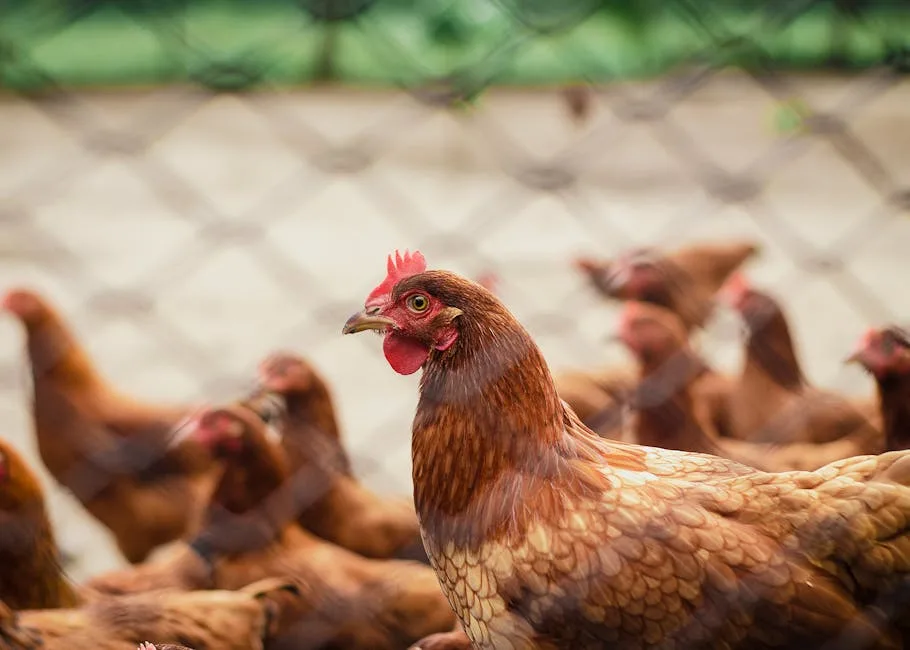
Best heat-tolerant breeds for Hawaii:
- •Leghorn: The classic Mediterranean breed. Light body, large single comb that dissipates heat efficiently, and an incredible production record (280-320 white eggs per year). Active foragers that handle tropical conditions well. The large comb, which is a frostbite risk in Iowa, is exactly what you want in Hawaii.
- •Egyptian Fayoumi: Bred in the Nile delta for extreme heat. Small body, upright posture, and exceptional disease resistance. Lays around 150-200 small white eggs per year. Hard to find on the mainland but worth seeking out from Hawaii hatcheries.
- •Andalusian: Mediterranean blue-feathered breed with a large comb and a slim, athletic body. Excellent heat tolerance, lays around 150-180 white eggs per year. Flighty and prefers free-ranging.
- •Minorca: The largest Mediterranean breed. Glossy black plumage, very large comb and wattles, and high heat tolerance. Lays large white eggs at a steady clip.
- •Sussex: Surprisingly versatile. The Speckled and Light Sussex varieties handle warm climates well thanks to lighter plumage and active foraging habits. Lays 250-280 brown eggs per year and tolerates both heat and humidity better than most heavy breeds.
- •Easter Egger: Hybrid birds with pea combs (less heat dissipation than a single comb but no frostbite risk to worry about anyway) and varied plumage. Generally hardy and good for mixed backyard flocks. Lays blue, green, or pink eggs.
- •Rhode Island Red: Surprisingly adaptable. Not the first choice for extreme heat, but reliable layers (250-300 eggs per year) that handle tropical conditions if you provide shade and ventilation.
Breeds to avoid in Hawaii:
- •Buff Orpington, Brahma, Cochin, and other heavy fluffy breeds: Built for cold. Their dense feathering traps heat against the body and they overheat fast in tropical conditions. Skip them entirely.
- •Wyandotte: Rose combs and dense plumage make this breed a poor choice for Hawaii. They will survive but they will struggle.
- •Silkie: Fluffy plumage and inability to fly to higher roosts makes this breed vulnerable to ground predators and heat stress in Hawaii. Some keepers do well with them in shaded, cooler upland areas like Volcano Village or Kula, but they are not a default pick.
If you are starting a Hawaii flock, lean Mediterranean. The breeds developed for Italian, Spanish, and North African climates are the same breeds that will thrive in Hilo, Lihue, or Pearl City.
Year-Round Heat Management
Hawaii does not have a winter. Coastal areas like Honolulu, Kailua-Kona, and Lihue stay in the 70s and 80s year-round, with summer highs in the upper 80s and low 90s. Humidity is constantly high, especially on the windward sides of each island. Your job, year-round, is keeping the flock cool, dry, and well-ventilated.
Heat and humidity management:
- •Shade is non-negotiable. Plant trees, install shade cloth, or build your run under an existing canopy. Direct sun in the 80s with high humidity can push chickens into heat stress within hours. A run with no shade is dangerous in Hawaii.
- •Open-air coops work better than enclosed ones. Traditional mainland coop designs trap heat and moisture. Many Hawaii keepers use three-sided coops, A-frames with open ends, or hoop tractors with shade cloth roofs. Cross-ventilation matters more than insulation everywhere except the upland areas (Volcano, Kula, Waimea) where nighttime temperatures can drop into the 50s.
- •Cool, fresh water at all times. Check waterers twice a day minimum, more in dry leeward areas like Kona. Add ice during heat waves. Place waterers in deep shade where they stay cool longer.
- •Watch for heat stress. Panting, holding wings out from the body, pale combs, and lethargy are warning signs. Move stressed birds to shade and offer cool electrolyte water immediately. Heat stress can kill a chicken in under an hour at the wrong temperature.
- •Freeze treats. Frozen watermelon, cucumbers, berries, or scratch grains frozen into ice blocks help cool birds on hot afternoons.
- •Provide a dust bath. Mites and lice thrive in Hawaii's warm humidity year-round. A dust bath with diatomaceous earth and wood ash helps your flock manage parasites naturally.
- •Manage mud and standing water. Heavy rain on the Hilo side of the Big Island, Hanalei on Kauai, or Kaneohe on Oahu means your run can become a swamp. Wet feet and damp bedding cause bumblefoot and respiratory issues. Use coarse mulch, gravel, or sand in high-traffic areas to keep things draining.
- •Cool-weather wisdom for upland areas. If you live in Volcano, Kula, Waimea, or other upland communities, nighttime lows in the 40s or 50s during winter months are normal. A draft-blocked but well-ventilated coop and a windbreak handle this without supplemental heat. Even at elevation, Hawaii chickens never need heat lamps.
The biggest difference from mainland keeping: airflow is your friend, and a coop that would be perfect in Iowa is a deathtrap in Hilo. Build for ventilation first, weather protection second.
If you are scaling up your setup, our guide to the best chicken coops on Amazon covers open-air and partially-enclosed designs that work well in warm climates. For run fencing, see our chicken run fencing and netting roundup.
Common Predators in Hawaii
Hawaii's predator list is unlike anywhere else in the country. There are no foxes, raccoons, opossums, skunks, weasels, coyotes, or bobcats. What Hawaii does have is its own short list of efficient chicken killers that mainland coop designs were never built to stop.
The main threats:
- •Mongoose: The single biggest predator threat on Oahu, Maui, Molokai, and the Big Island. Small Indian mongooses were introduced in the 1880s to control rats and quickly became the dominant chicken predator instead. They climb, dig, and squeeze through any opening larger than about an inch. They hunt during the day, take eggs and chicks readily, and will kill adult birds. Kauai is the only main Hawaiian island without an established mongoose population.
- •Feral cats: A serious threat statewide. Hawaii has one of the largest feral cat populations per capita in the United States. They climb fences, slip through small openings, and target chicks and bantams especially. A well-built coop with a covered run handles this.
- •Rats: Both Norway rats and roof rats are present statewide and will eat eggs, kill chicks, and contaminate feed. Sealed feed storage and a tight coop are non-negotiable.
- •Hawks (Io): The endemic Hawaiian hawk lives only on the Big Island and is federally protected. It will take chickens. The pueo (Hawaiian short-eared owl) is also present statewide and can hunt at dawn and dusk. Cover your run.
- •Wild and feral pigs: Mostly an issue on rural Big Island, Maui, and Kauai properties. Pigs will tear apart a flimsy coop to get to eggs and chicks. A solid run frame and reinforced perimeter help.
- •Stray and free-roaming dogs: A leading cause of chicken losses in suburban Hawaii. A fenced yard plus a secure run handles this.
Predator-proofing for Hawaii:
- •Use 1/2-inch hardware cloth everywhere. Chicken wire stops nothing in Hawaii. The standard mainland recommendation is even more critical here because mongooses can pass through anything larger.
- •Bury or apron the wire. Run a 12-inch hardware cloth apron along the ground around your coop and run, staked down with picture staples. Mongooses dig aggressively.
- •Improve the coop. Raise the sleeping quarters 18-24 inches off the ground. This reduces rat harborage and makes the coop harder for predators to access.
- •Lock the coop every night. Even though mongoose hunt during the day, feral cats and owls work at night. An automatic coop door is a great Hawaii investment.
- •Sealed feed storage. Use metal trash cans with tight lids. Anything plastic gets chewed through by rats.
- •Cover the run. Aerial netting or hardware cloth on top stops hawks, owls, and climbing cats.
A coop built to mainland predator standards will fail in Hawaii because the predator list is different. Build for mongooses and cats first; everything else falls into place.
FAQ
Do I need a permit to keep chickens in Hawaii?
No, none of the four Hawaii counties require a permit for small backyard flocks in zones where chickens are allowed. Honolulu caps residential keeping at two hens with no permit needed. Hawaii County and Maui County allow flocks tied to lot size with no permit. Kauai allows small flocks in residential zones without a permit. The Hawaii Department of Agriculture does encourage all keepers to register their flock for disease tracking.
How many chickens can I have in Hawaii?
It depends entirely on your county and zoning. Honolulu (Oahu) allows two hens per household in residential zones, period. Hawaii County (Big Island) allows four hens on lots up to 5,000 square feet plus one more per 1,000 square feet beyond that. Maui and Kauai tie limits to lot size and zoning, with rural ag lots effectively unrestricted. Agricultural zones across all four counties allow much larger flocks.
Why are there so many wild chickens in Hawaii?
The feral population, called moa in Hawaiian, descends from Red Junglefowl brought by Polynesian voyagers over a thousand years ago. The Kauai population exploded after Hurricane Iniki in 1992 destroyed most of the island's backyard coops, releasing domestic birds that interbred with the ancestral wild flock. Kauai's lack of mongooses (every other main island has them) means the population has nothing keeping it in check. Oahu also has feral populations in valleys and parks, though they are smaller than Kauai's.
Is it illegal to feed feral chickens in Hawaii?
On Kauai, yes. Feeding feral chickens or attempting to feed them carries fines up to $500 per bird. Hawaii passed Act 185 (SB2401) in 2024 to fund feral chicken control across the state and discourage feeding through public education campaigns. Other counties are implementing their own enforcement under that framework.
Are roosters legal in Hawaii?
Roosters are not legal in Hawaii County's residential zones (Bill 52, 2025) or Maui County's high-density residential zones. Honolulu does not explicitly ban roosters but enforces a strict animal nuisance ordinance that effectively makes them impractical in dense residential areas. Kauai restricts them in residential zones. Agricultural zones across all four counties generally allow roosters subject to nuisance standards.
What's the best chicken breed for Hawaii?
Leghorns are the best all-around choice for Hawaii. The breed evolved in the Mediterranean and handles heat and humidity exceptionally well, with the large single comb serving as a built-in radiator. For variety, the Egyptian Fayoumi is the most heat-tolerant breed in existence, and Sussex and Easter Eggers round out a good Hawaii starter flock. Avoid heavy fluffy breeds like Buff Orpingtons, Brahmas, and Cochins.
Can I sell eggs from my backyard flock in Hawaii?
Yes, with some rules. Direct, non-commercial sales to neighbors and friends operate with minimal oversight: wash eggs with potable water, refrigerate at 45F or below, and label as "ungraded." Retail sales (farm stands, farmers' markets, stores) require a permit from the Hawaii Department of Health and compliance with Hawaii's Standards for Shell Eggs administered by the Hawaii Department of Agriculture.
Your first step to keeping chickens in Hawaii is checking your county code and any HOA covenants on your property. Honolulu's two-hen residential cap surprises a lot of newcomers, and Hawaii County's recent Bill 52 changed the rules dramatically for Big Island keepers. Once you know what's allowed, focus on heat-tolerant breeds and a coop built for ventilation, mongoose-resistance, and tropical rain. For a full walkthrough of getting started, check our beginner's guide to raising backyard chickens and our summer chicken care guide, which covers heat management strategies that apply in Hawaii year-round.
Picking a coop for Hawaii? Most mainland coop designs are built for cold and trap heat in tropical conditions. Our best chicken coops on Amazon roundup covers options with strong ventilation that work better in warm climates, and our coop bedding guide compares bedding choices that handle Hawaii's humidity.
Raising Chickens in Other States
If you're moving, considering a different state, or just curious how the rules compare, browse our other state guides:
Northeast: Connecticut, Delaware, Maine, Maryland, Massachusetts, New Hampshire, New Jersey, New York, Pennsylvania, Rhode Island, Vermont
Southeast: Alabama, Florida, Georgia, Kentucky, Louisiana, Mississippi, North Carolina, South Carolina, Tennessee, Virginia, West Virginia
Midwest: Illinois, Indiana, Iowa, Kansas, Michigan, Minnesota, Missouri, Nebraska, North Dakota, Ohio, South Dakota, Wisconsin
South & Southwest: Arizona, Arkansas, New Mexico, Oklahoma, Texas
Mountain & West: Alaska, California, Colorado, Idaho, Montana, Nevada, Oregon, Utah, Washington, Wyoming
Related Guides
Raising Chickens in Nevada: 2026 Laws & Desert Tips
Raising chickens in Nevada: laws for Las Vegas, Henderson, Reno, plus heat-tolerant breeds and desert chicken care tips.
State GuidesRaising Chickens in New Mexico: 2026 Laws & Desert Tips
Raising chickens in New Mexico: laws for Albuquerque, Las Cruces, Santa Fe, plus heat-tolerant breeds for the high desert.
State GuidesBackyard Chicken Laws: Permits, HOAs & Rules by State (2026)
Can you legally keep backyard chickens? How city limits, zoning, HOAs, permits, flock limits, and rooster bans work, plus how to find your local rules.
State GuidesRaising Chickens in Alaska: 2026 Laws & Best Breeds
Raising chickens in Alaska: laws for Anchorage, Fairbanks, Juneau, plus extreme cold-hardy breeds and sub-arctic care tips.