Dominique Chicken Breed Guide: America's Oldest Hen
Dominique chickens are America's oldest breed: rose-combed, barred, cold-hardy layers. Learn their eggs, size, temperament, and Barred Rock differences.
Researched from university extension, USDA, and veterinary sources. How we research.
The Dominique is America's oldest chicken breed, a barred, rose-combed homestead bird that was scratching around colonial dooryards before the country had a flag. Hens lay around 230 to 275 medium brown eggs a year, handle cold winters without fuss, forage hard, and make excellent broody mothers. If you want a calm, hardy, dual-purpose bird with genuine American history behind it, and you can tell it apart from a Barred Plymouth Rock, the Dominique is one of the most rewarding heritage breeds you can keep.
What You'll Learn
- •Dominique Chicken Overview
- •History and Origin
- •What Do Dominique Chickens Look Like?
- •Dominique vs Barred Plymouth Rock
- •How Big Do Dominique Chickens Get?
- •Dominique Chicken Temperament
- •How Many Eggs Do Dominique Chickens Lay?
- •Are Dominique Chickens Cold Hardy?
- •Are Dominique Chickens Good for Beginners?
- •Dominiques as Dual-Purpose Birds
- •Housing and Space Requirements
- •Feeding Your Dominique Chickens
- •Health Issues to Watch For
- •Where to Buy Dominique Chickens
- •Frequently Asked Questions
Dominique Chicken Overview
| Trait | Details |
|---|---|
| Origin | United States (colonial New England, established by the 1750s) |
| Also called | Dominicker, Pilgrim Fowl, Old Grey Hen |
| Size | Roosters: 7 lbs, Hens: 5 lbs |
| Egg Production | 230-275 eggs/year |
| Egg Color | Brown (medium) |
| Comb | Rose comb (frostbite resistant) |
| Temperament | Calm, docile, friendly, alert forager |
| Cold Hardy | Yes, exceptionally |
| Heat Tolerant | Good |
| Broody | Yes, excellent mothers |
| Beginner Friendly | Yes |
| Conservation Status | Watch (Livestock Conservancy) |
History and Origin
The Dominique holds a title no other bird can claim: it is the oldest chicken breed developed in the United States. Its roots trace to the barred fowl that colonists carried from southern England to New England in the 1600s and 1700s. By the 1750s these grey, barred chickens were common enough on farms up and down the eastern seaboard to be recognized as a distinct type. People called them Dominiques, Dominickers, Pilgrim Fowl, or simply the "old grey hen."
Nobody sat down and designed the Dominique the way later breeders designed birds for the show bench. It came together the way most old landraces did: through generations of farm families keeping the hardiest, most productive birds that could feed a household on kitchen scraps and whatever they scratched up in the yard. That practical origin is why the breed is so tough and self-reliant today.
The Dominique was a fixture of 19th-century American life. It appeared at the country's first poultry exhibition in Boston in 1849, and it was one of the breeds written into the American Poultry Association's very first Standard of Excellence in 1874. Its feathers were prized for stuffing pillows and mattresses, and its steady laying and respectable table weight made it the default backyard bird for much of the century.
Early on, both rose-combed and single-combed Dominiques existed side by side. In the 1870s the poultry fancy settled the matter: only rose-combed barred birds would carry the Dominique name, while the single-combed barred birds were folded into the emerging Plymouth Rock. The Barred Plymouth Rock was in fact built partly on Dominique stock, which makes the Dominique a direct ancestor of one of America's most popular chickens.
Then the breed nearly disappeared. As industrial hybrids took over egg and meat production in the 20th century, Dominique numbers collapsed. By 1970 a survey turned up only four known flocks in the entire country. The American Livestock Breeds Conservancy, now The Livestock Conservancy, organized a recovery effort in the 1970s, breeders rallied around it, and the population climbed back. The Dominique is still listed as a breed to Watch, but it is no longer on the edge of extinction. Every backyard flock that keeps a few helps hold the line for the country's founding chicken.
What Do Dominique Chickens Look Like?
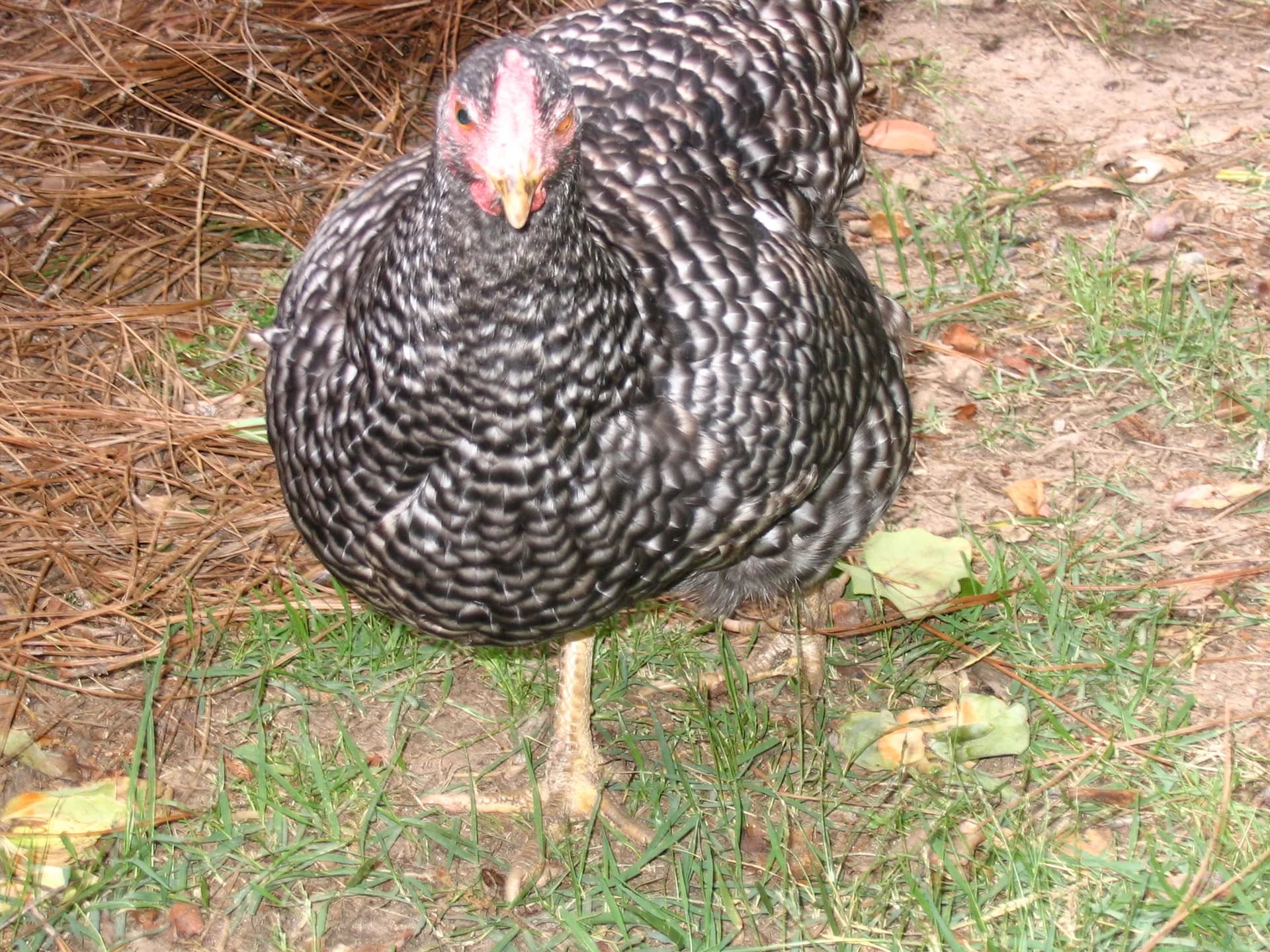
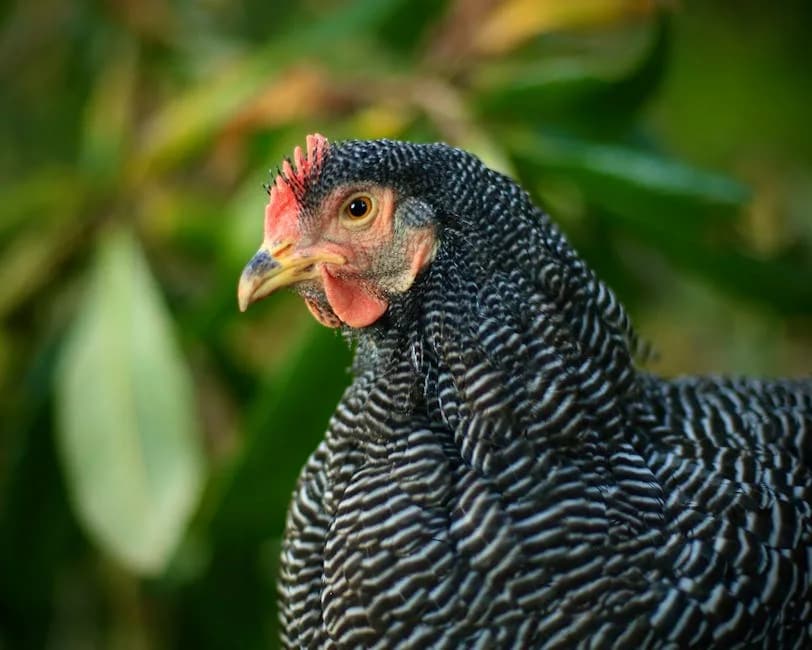
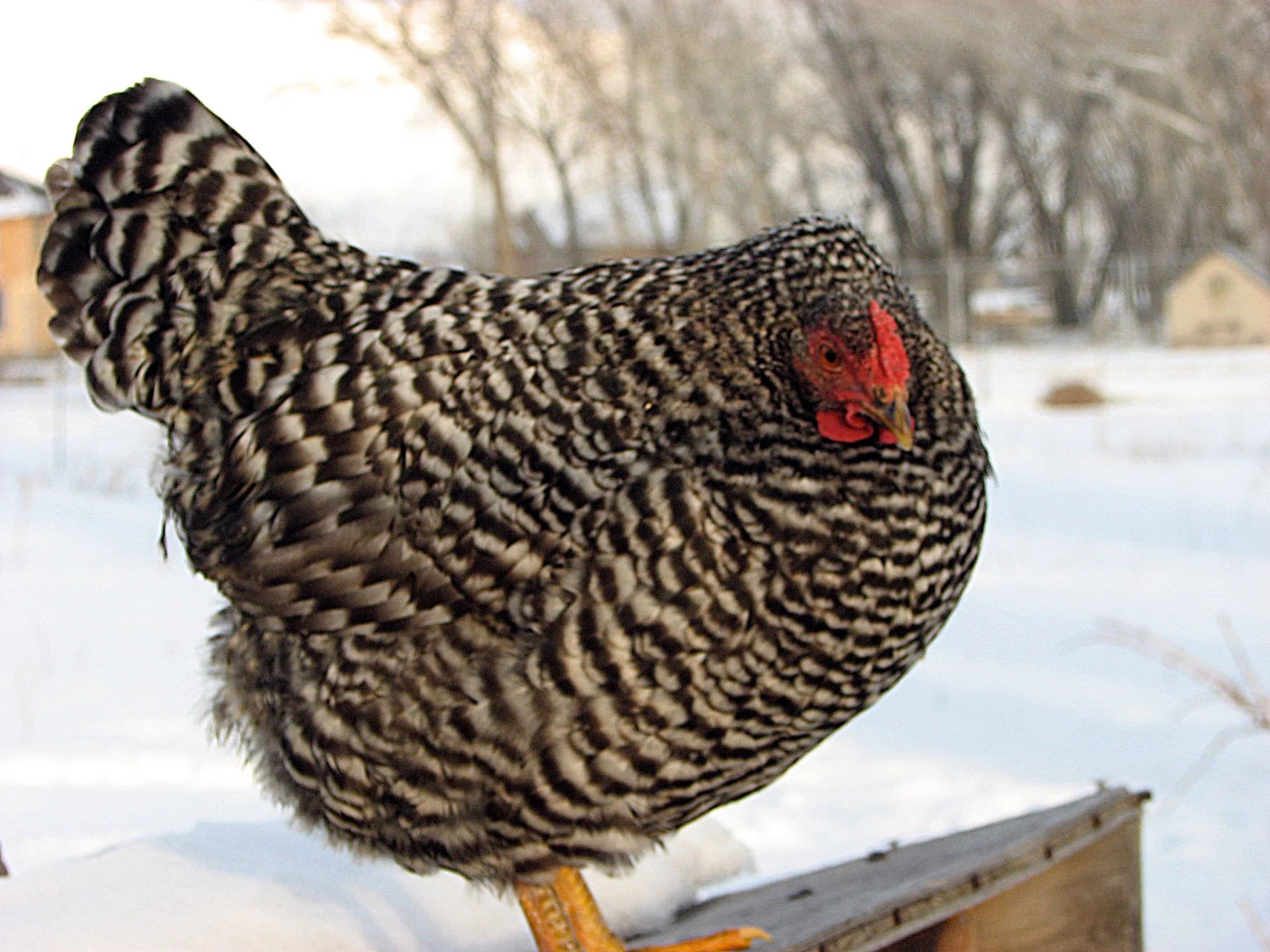
Dominiques are a handsome, medium-sized bird with a distinctive grey, barred coat. The plumage is a "cuckoo" or barred pattern: every feather carries alternating bands of black and slate-white that blend, from a distance, into an overall soft grey. Keepers often describe the effect as "hawk coloring," and it gives the bird a bit of natural camouflage against predators.
Look closely and the barring is slightly irregular and staggered, with a soft, slate-toned edge rather than crisp, ruler-straight lines. This matters, because it is one of the ways you tell a Dominique from a Barred Rock (more on that below).
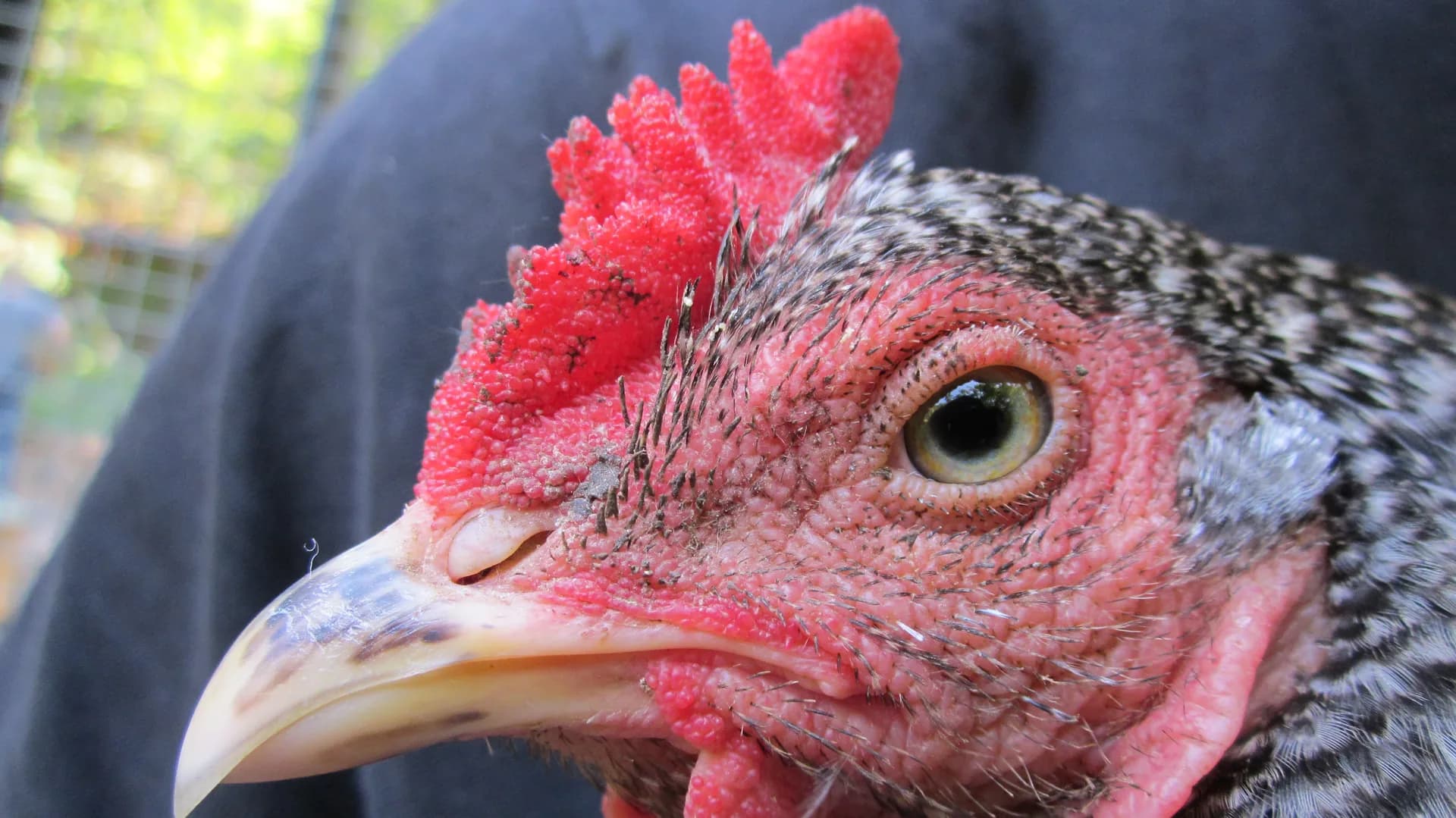
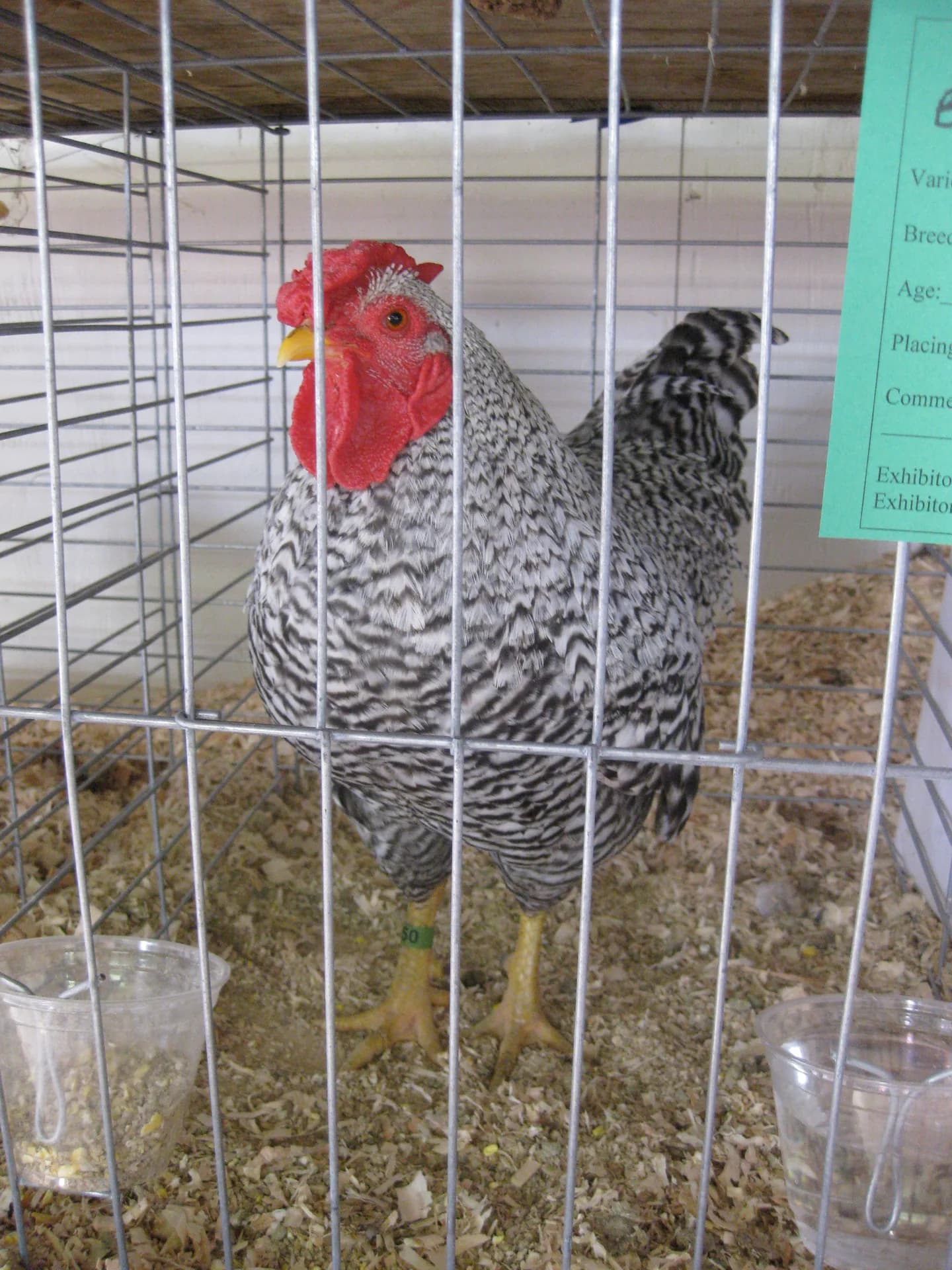
The breed's signature feature is its rose comb: a low, flat comb covered in small rounded points, finishing in a short backward-pointing spike at the rear. It sits close to the head instead of standing tall, which is exactly why the breed shrugs off frostbite. The comb, wattles, and earlobes are red. The beak is yellow with some dark shading, the eyes are a reddish bay, and the skin, legs, and clean (unfeathered) shanks are yellow.
Overall the body is medium-sized with a gently sloping, slightly U-shaped back and a full tail carried at a jaunty angle, higher in roosters than in hens. There is also a bantam Dominique, though the standard large fowl is what most backyard keepers raise.
Dominique vs Barred Plymouth Rock
This is the question that trips up almost everyone, and for good reason. A Dominique and a Barred Plymouth Rock are both grey, barred, yellow-legged American breeds, and they share ancestry. People mix them up constantly, and some birds sold as "Dominiques" at feed stores are actually Barred Rocks. Here is how to tell them apart.
| Trait | Dominique | Barred Plymouth Rock |
|---|---|---|
| Comb | Rose comb (flat, spike at rear) | Single comb (tall, upright, serrated) |
| Barring | Irregular, staggered, soft slate-grey | Crisp, straight, sharp black-and-white |
| Hen weight | 5 lbs | 7.5 lbs |
| Body shape | Slimmer, sloping back | Fuller, deeper, more upright |
| Origin | 1750s (America's oldest) | 1860s (derived partly from Dominique) |
| Availability | Uncommon | Very common |
The single most reliable test is the comb. If the bird has a flat rose comb that ends in a little spike, it is a Dominique. If it has a tall single comb with the classic saw-tooth points standing straight up, it is a Barred Rock. This one feature is definitive, so when you buy chicks or birds, check the comb type first.
The plumage is the second tell. Dominique barring is a touch narrower, more staggered, and softer in tone, giving a slightly hazier grey. Barred Rock barring is bolder, straighter, and more sharply black-and-white. Size helps too: a Barred Rock hen outweighs a Dominique hen by a couple of pounds and looks blockier. If you want the full rundown on the more common cousin, see our Plymouth Rock breed guide.
How Big Do Dominique Chickens Get?
Dominiques are a true medium breed, smaller and lighter than the Barred Rock or the heavy dual-purpose birds. Here is how they measure up under the American Poultry Association standard:
- •Roosters: 7 lbs (3.2 kg)
- •Hens: 5 lbs (2.3 kg)
- •Cockerels: about 6 lbs
- •Pullets: about 4 lbs
- •Bantam Dominiques: roughly 24 to 28 oz
That moderate size is part of the breed's charm. A 5-lb hen eats less than a 7 or 8-lb heavy breed while still laying a full basket of eggs, which made the Dominique an efficient homestead bird for centuries. Roosters are big enough to make a decent table bird but not so large that they bully the flock.
Growth is steady rather than fast. Like most heritage breeds, Dominiques take their time filling out compared to a commercial hybrid, usually reaching full size around 16 to 20 weeks. What you get in return is a healthy, active bird with a long productive life.
Dominique Chicken Temperament
Temperament is where Dominiques win a lot of loyal keepers. They are famously calm, steady, and easy to live with.
Docile and friendly. Dominiques are gentle, unflappable birds that handle well and rarely panic. They tolerate children and make a fine family flock. Most warm up to their keepers and will come running at chore time, though they are not usually lap chickens by default.
Alert foragers. Underneath the calm exterior is a switched-on bird. Dominiques are excellent foragers that cover ground, scratch, and hunt bugs all day when given range. Their barred camouflage and natural alertness also make them better than average at spotting hawks and other predators, which is a real advantage for a free-range flock.
Good with confinement, better with room. Dominiques adapt to a run and coop setup more readily than some active breeds, but they shine with space to roam. Give them room and they will offset a meaningful part of their feed bill by ranging.
Mellow roosters. Dominique cockerels have a reputation for being calmer and less aggressive than many breeds. As with any rooster, handle them regularly while young and watch for the occasional pushy individual, but as a group they are easygoing.
Broody and maternal. Dominique hens go broody readily and are attentive, protective mothers. If you would rather hatch chicks under a hen than run an incubator, this is one of the better breeds for the job.
How Many Eggs Do Dominique Chickens Lay?
Dominique hens are dependable layers, especially for a heritage breed that also earns its keep in other ways. Here are the numbers:
- •Annual production: 230 to 275 eggs per year
- •Weekly average: 4 to 5 eggs at peak
- •Egg size: Medium
- •Egg color: Brown
- •Start of lay: around 6 months (21 to 24 weeks)
That output puts Dominiques comfortably in the "good layer" range. You will not match a purpose-bred production hybrid over a single peak year, but Dominiques lay steadily and keep at it for more seasons than a burned-out commercial layer, which is what heritage breeds are known for. Real-world backyard numbers often land closer to 180 to 260 depending on your climate, feed, and daylight, so treat the top of the range as a best case.
Their hardiness pays off in winter. A cold-tolerant rose-combed bird tends to keep laying through cold snaps that slow more delicate breeds. Production still dips as daylight shortens, so if you want steadier winter eggs, our winter chicken care guide covers supplemental lighting and cold-weather management.
Because Dominique hens go broody so willingly, expect a pause in laying when a hen decides to sit. That is a feature if you want chicks: a broody Dominique will happily hatch and raise a clutch. Our egg incubation guide walks through the 21-day hatch if you would rather run an incubator, and our best egg-laying breeds roundup shows how Dominiques compare on pure output.
Are Dominique Chickens Cold Hardy?
Yes, and it is one of the breed's best traits. Dominiques were shaped by New England winters, and everything about them reflects it.
The rose comb is the key. A tall single comb has a lot of thin, exposed surface area that freezes easily, which is why so many breeds lose comb tips to frostbite. A rose comb sits low and flat against the head, so there is very little tissue sticking up to freeze. Pair that with the Dominique's tight, dense feathering and you have a bird genuinely built for the cold.
In practice, Dominiques handle sub-freezing weather with little help as long as you cover the basics: a dry, draft-free but well-ventilated coop, deep dry bedding, and access to unfrozen water. You will rarely worry about frostbitten combs the way you would with a single-combed breed. For the full cold-weather playbook, read how to keep chickens warm in winter.
Dominiques handle heat reasonably well too. They are not a heavy, dark bird, and their moderate size helps them shed warmth. In hot southern summers, give them deep shade, cool water, and airflow and they will be fine. Cold is where they excel, but they are more adaptable across climates than many heritage breeds.
Are Dominique Chickens Good for Beginners?
Yes. Dominiques are one of the more forgiving heritage breeds for a first flock.
Hardy and low-maintenance. They are cold-tolerant, adaptable, disease-resistant, and free of the fussy health quirks that come with some fancy breeds. Fewer surprises while you are learning.
Calm enough to learn on. Their gentle, steady nature makes daily chores, health checks, and handling straightforward. Flighty, nervous breeds make everything harder for a new keeper. Dominiques do not.
Efficient foragers. Given space, Dominiques offset a real portion of their diet by ranging, a nice bonus for a beginner watching the budget.
Dual-purpose flexibility. You do not have to decide up front between eggs and meat, and broody hens give you a path to raising your own replacements without buying an incubator.
The one thing to watch is buying the real thing. Because Dominiques and Barred Rocks look so similar, birds are sometimes mislabeled. Buy from a reputable hatchery or breeder, and confirm the rose comb so you know you are getting a true Dominique. If you are comparing options, our best chicken breeds for beginners guide lines up the top choices side by side.
Dominiques as Dual-Purpose Birds
"Dual purpose" means a breed productive enough for both eggs and meat, and the Dominique filled that role on American homesteads for the better part of two centuries.
On the egg side, you get 230 to 275 medium brown eggs a year from an efficient, moderate-sized hen that keeps laying through winter better than most. That is plenty to keep a family in eggs year-round from just a few birds.
On the meat side, Dominiques are a smaller carcass than a Barred Rock or a Jersey Giant, but a 7-lb rooster still dresses out into a respectable, well-flavored bird. The meat is leaner and firmer than a Cornish Cross, the way heritage chicken is meant to taste, and extra cockerels from a straight-run order make a natural meat crop.
Because they forage so well and hens raise their own chicks, Dominiques are a strong pick for anyone leaning toward a self-reliant, low-input setup. If meat is part of your plan, our raising chickens for meat guide covers timelines and processing, and our dual-purpose chicken breeds overview shows how the Dominique stacks up against other do-it-all birds.
Housing and Space Requirements
Dominiques are not demanding about housing, but a few basics keep them healthy and productive.
Coop space: Plan for at least 4 square feet per bird inside the coop. Dominiques are a moderate size, so they need a bit less than the heaviest breeds, but do not crowd them.
Run space: Give them a minimum of 10 square feet per bird in the run, and more if you can. Free-range access is ideal for this active, foraging breed.
Roosting bars: Provide 8 to 10 inches of roost per bird. Dominiques roost readily and are light enough that high bars are not a problem.
Nesting boxes: One box for every 3 to 4 hens. Standard 12x12 inch boxes work well. Our nesting box guide covers setup.
Ventilation: Dominiques are cold-hardy, but that hardiness depends on a dry coop. Never seal a coop up tight to "keep them warm." Trapped moisture causes far more frostbite and respiratory trouble than cold air does. Put ventilation up high, above the birds, with no direct drafts on the roost. Our how to build a chicken coop guide covers ventilation in detail.
Fencing and predators: Dominiques are alert and their barred coloring gives them some natural cover, but they still range eagerly, so predator protection matters. See our guide to protecting your flock from predators and our chicken run fencing options.
Feeding Your Dominique Chickens
Dominiques do not need a specialized diet. Get the fundamentals right and they thrive.
Chicks (0-8 weeks): Starter feed with 18 to 20% protein, with clean water available at all times. Our raising chicks week-by-week guide lays out a full schedule.
Pullets (8-18 weeks): Grower feed at 16 to 18% protein to support steady growth without pushing them to lay too soon.
Laying hens (18+ weeks or once laying begins): Layer feed at 16% protein with added calcium for strong shells. Put out crushed oyster shell free-choice on the side so each hen takes what she needs.
Roosters and non-layers: An all-flock or maintenance feed at around 16% protein. Roosters do not need the extra calcium in layer feed, and too much over time can stress their kidneys.
Foraging and treats: This is where Dominiques earn their keep. Given range, they supplement a meaningful share of their diet with bugs, seeds, and greens, which also keeps them busy and content. Keep treats and scraps under about 10% of the total diet, and always provide grit if they do not have access to bare ground. For the full breakdown, see our complete chicken feeding guide.
Health Issues to Watch For
Dominiques are one of the hardier breeds you can keep, with no notable breed-specific diseases. That said, a few general items are worth staying on top of.
External parasites. Mites and lice affect every breed. Check regularly around the vent and under the wings, and keep a dry dust-bathing spot available. The rose comb's folds can occasionally harbor mites, so include the head area in your checks.
Broody-hen weight loss. Dominique hens go broody often and sit tight. A dedicated broody can lose condition over a long sit, so make sure she leaves the nest to eat and drink, and break up a broody hen who is not raising chicks.
Reduced rooster fertility. The rose comb gene is genetically linked to lower sperm motility in roosters that carry two copies of it. It is not a health problem, but if you plan to hatch and see poor fertility, it is a known quirk of rose-combed breeds worth knowing about.
Bumblefoot. Any bird jumping from high roosts onto hard surfaces can bruise its footpads and develop this bacterial infection. Keep roosts at a reasonable height and use soft bedding underneath.
For a full rundown of warning signs, read our guide to sick chicken symptoms every owner should recognize.
Where to Buy Dominique Chickens
Because Dominiques are uncommon, plan to order rather than count on finding them at a feed store. Your options:
Hatcheries. Several major hatcheries carry Dominiques as day-old chicks, including Cackle Hatchery, Murray McMurray, Meyer Hatchery, and Hoover's. Expect roughly $4 to $7 per chick depending on quantity and sexing.
Breeders. For birds closest to the breed standard, buy from a dedicated breeder. The Dominique Club of America and The Livestock Conservancy's breeder directory are the best places to find one. Breeder stock costs more, often $10 to $20 per chick or started bird, but you get better type and true rose-combed genetics.
Hatching eggs. If you run an incubator or have a broody hen, fertile Dominique eggs are available online, usually $3 to $6 per egg. Our hatching guide covers the process start to finish.
Confirm the comb. Whatever the source, verify the birds have a rose comb, not a single comb. This is the difference between a true Dominique and a mislabeled Barred Rock.
Minimum orders. Most hatcheries require a minimum number of chicks (often 3 to 6, sometimes more) so the birds stay warm in transit. Order early in the season for the best availability, since heritage breeds sell out faster than common ones.
Getting set up? Whatever breed you land on, the coop matters as much as the bird. Our best chicken coops on Amazon roundup covers current picks across flock sizes and budgets, from small starter coops to walk-in models.
Frequently Asked Questions
Are Dominique chickens the same as Barred Plymouth Rocks?
No, though they look alike and share ancestry. The quickest way to tell them apart is the comb: Dominiques have a flat rose comb that ends in a small spike, while Barred Rocks have a tall single comb. Dominiques are also lighter, with softer, more staggered barring. The Barred Rock was actually developed partly from Dominique stock in the 1800s.
How many eggs do Dominique chickens lay per year?
Dominique hens lay about 230 to 275 medium brown eggs per year, roughly 4 to 5 a week at their peak. Backyard results often land closer to 180 to 260 depending on climate and daylight. They are dependable layers and hold up better in winter than many breeds thanks to their cold-hardy rose comb.
Is the Dominique the oldest American chicken breed?
Yes. The Dominique is recognized as the oldest chicken breed developed in the United States, tracing back to barred fowl brought to New England by colonists and established as a distinct type by the 1750s. It was one of the breeds in the American Poultry Association's first standard in 1874.
Are Dominique chickens rare or endangered?
They are uncommon but no longer in danger of disappearing. By 1970 only four flocks were known to survive, but a recovery effort led by The Livestock Conservancy brought the breed back. It is now listed as a breed to Watch, meaning it is recovering but still deserves support from backyard keepers.
Are Dominique chickens cold hardy?
Very. They were shaped by New England winters and carry a low rose comb that resists frostbite far better than a tall single comb. Combined with dense, tight feathering, this makes them one of the best breeds for cold climates. They also tolerate heat reasonably well, which makes them adaptable across regions.
Are Dominique chickens friendly and good with kids?
Generally yes. Dominiques are calm, docile, and easy to handle, which makes them a good choice for families and first-time keepers. Roosters tend to be mellower than average, though as with any rooster you should handle cockerels regularly while they are young.
Do Dominique hens go broody?
Yes, readily. Dominique hens are known for going broody and for being attentive, protective mothers. If you want to hatch and raise chicks naturally rather than with an incubator, a broody Dominique is one of the better heritage breeds for the job.
Are Dominique chickens good for meat?
They are a solid dual-purpose bird. Dominiques are smaller than a Barred Rock, but a 7-lb rooster still makes a respectable table bird with the leaner, firmer meat typical of heritage chicken. Extra cockerels from a straight-run order are a natural meat crop alongside the hens' egg production.
The Dominique is a true American original: a calm, cold-hardy, hard-foraging dual-purpose bird that came within four flocks of vanishing and fought its way back. If you value hardiness, self-reliance, and a piece of the country's history in your backyard, it is one of the most rewarding heritage breeds you can raise. To see how it compares with other top choices, browse our best chicken breeds for beginners guide.
Sources:
- •The Livestock Conservancy. Dominique Chicken breed page. https://livestockconservancy.org/heritage-breeds/heritage-breeds-list/dominique-chicken/
- •Dominique Club of America. Breed history and standard. https://dominiqueclub.org/
- •Oklahoma State University, Department of Animal Science. Breeds of Livestock, Poultry. http://breeds.okstate.edu/poultry/
- •University of Kentucky Cooperative Extension. Small Flock Poultry resources. https://poultry.extension.org/
Image credits: Dominique rooster photo by Steven Walling (CC BY 3.0); Dominique hen photo by JapanBreakfast (CC BY-SA 3.0), both via Wikimedia Commons.
Related Guides
Bielefelder Chicken Breed Guide: The Auto-Sexing Hen
A big, gentle German dual-purpose breed whose chicks can be sexed at hatch by color. Calm, cold-hardy, and a steady layer of large brown eggs.
BreedsChantecler Chicken Breed Guide: Canada's Winter Hen
The Chantecler is Canada's first chicken breed: a cushion-combed, cold-hardy dual-purpose bird built to lay through brutal Quebec winters.
BreedsCuckoo Marans: Complete Breed Guide
Cuckoo Marans lay dark brown eggs and are the easiest Marans to find and sex. Guide to egg color, barred looks, temperament, care, and Cuckoo vs Black Copper.
BreedsAraucana Chicken Breed Guide: Blue Eggs, Tufts, Care
Araucana chicken breed guide: rumpless bodies, ear tufts, true blue eggs, the lethal tuft gene, care, and how they differ from Ameraucanas.