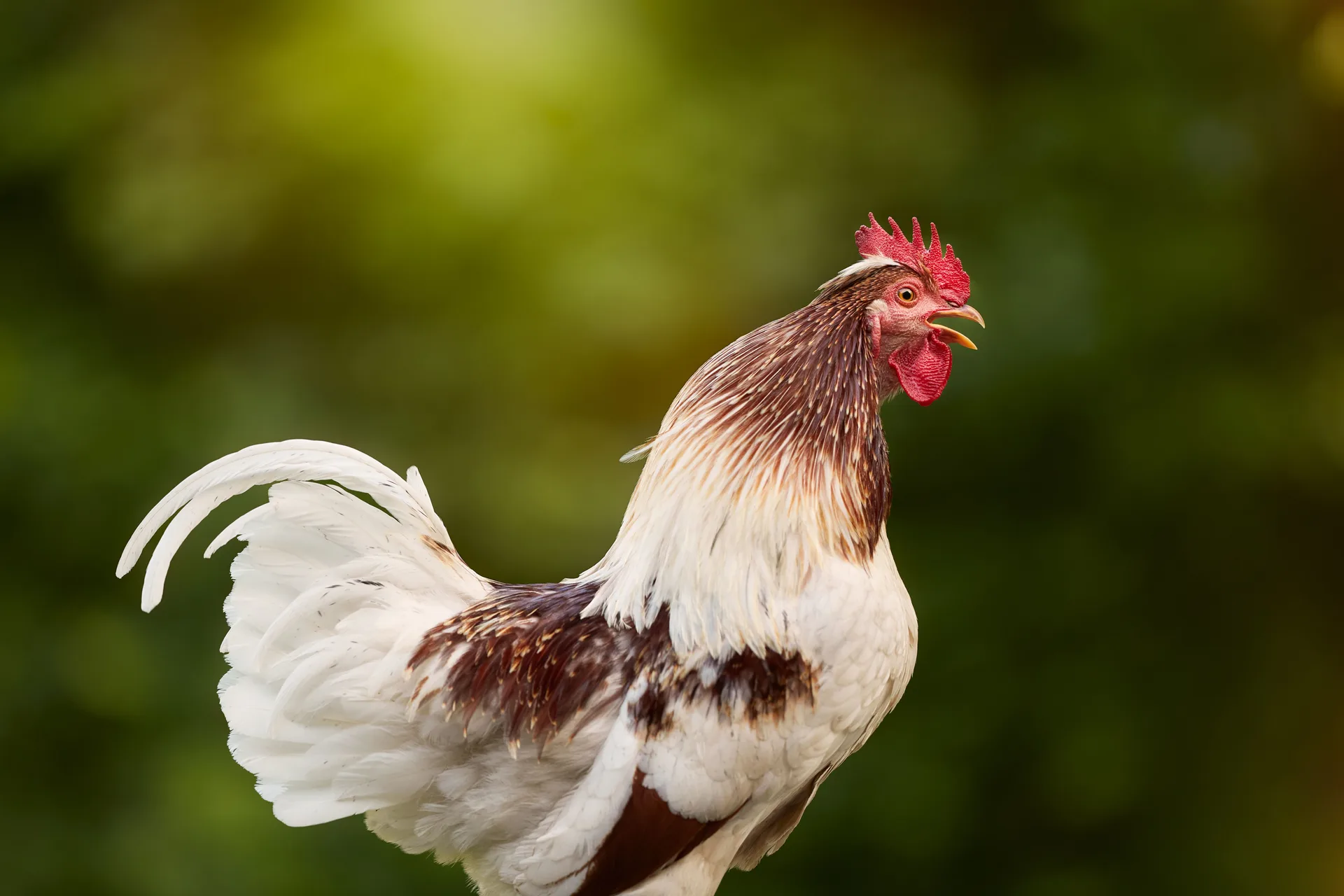
Chicken Sounds and What They Mean: A Guide to Flock Talk
What chicken sounds mean, from the egg song and the rooster's crow to the two alarm calls, the purr, and the growl. Plus how loud hens really are.
Researched from university extension, USDA, and veterinary sources. How we research.
Chickens talk all day. Anyone who has kept a flock for a season learns to pick out the soft contact clucks of hens foraging, the racket after an egg, the sharp note that sends everyone under the coop when a hawk crosses the yard, and the rooster's crow that starts before the sun. Researchers who have recorded chickens and their wild ancestor, the red junglefowl, have catalogued their calls and shown that several carry specific meaning: a hen hearing a food call will start searching the ground even when she cannot see the caller, and a flock hearing the aerial alarm reacts differently than it does to the ground alarm.
This guide covers the sounds you will hear most, what each one means, what to do about the ones that signal a problem, and the honest answer to the question every new keeper's neighbor asks: how loud are they?
The Everyday Sounds
Contact clucks
The quiet, steady "buk, buk, buk" a flock makes while foraging. It is the sound of a group keeping track of each other. The University of Minnesota's extension describes hen clucking as a soft tone, and it is: you will not hear it from inside the house. If the clucking stops all at once, look up, because they have seen something.
The purr or trill
A low rolling sound, something like a cat's purr, from a hen that is content. You hear it from a hen settling into a dust bath, from a bird being held by someone she trusts, and from a broody hen on her nest when nothing is bothering her. It is the closest thing chickens have to a sigh of comfort.
The egg song
The loudest sound a hen makes on purpose. After laying, and sometimes before, a hen lets loose a long run of "bok-bok-bok-BAGAWK" that other hens often join. It can go on for a minute or more and carries across a suburban lot. Nobody has proven exactly why hens do it. The common explanations are announcing the egg, calling the flock back together after she left it to lay, and drawing attention away from the nest. Whatever the reason, it is normal, it happens most in the morning, and it is the sound most likely to draw a comment from a neighbor. See our guide to when chickens start laying if your pullets have started singing before they have produced an egg; many practice first.
The food call
A fast, excited "tuk-tuk-tuk" from a bird that has found something worth eating. Roosters do it constantly to call hens over to a find, and hens do it for their chicks. Research at Macquarie University in Australia showed this call is a true signal, not just excitement: hens who heard a recorded food call started searching the ground in front of them, but not when they had just eaten, which means the call tells them something about food rather than simply winding them up.
Broody growl and squawk
A broody hen on her nest makes a low growl, fluffs up, and may screech when you reach under her. She is not sick or mean; she is defending eggs, real or imaginary. Our broody hen guide covers what to do next.
The complaint
Repetitive, insistent squawking from a hen who is being kept from something: a nest box that is occupied when she needs it, a run gate closed when she wants out, or a feeder that has run dry. The loud version is easy to confuse with the egg song. The difference is that it stops when she gets what she wants.
Chick sounds
Chicks peep softly and steadily when they are warm and fed. A loud, continuous, high-pitched peeping means cold, hunger, or a chick stuck somewhere. It is the most useful sound in the brooder, because the peeping tells you the temperature is wrong before the huddling does. See the brooder setup guide.
The Warning Sounds
Chickens have two alarm calls, and they are not interchangeable. Work by Christopher Evans and colleagues at Macquarie University showed that fowl give one call for a threat in the air and a different one for a threat on the ground, and that other chickens respond to each with the right escape behavior even when they cannot see the danger themselves.
Aerial alarm
A high, thin, drawn-out scream or whistle, often from the rooster, when a hawk, an owl, or sometimes a harmless heron or airplane passes overhead. The flock freezes, crouches, or runs for cover. If you have a rooster, this call is a large part of what he is for. Hens in an all-hen flock will give it too, usually the dominant bird.
Ground alarm
A loud, repetitive, cackling "buk-buk-buk-buk-BUK" at a raccoon, dog, cat, snake, or anything else approaching on foot. The flock scatters or flies up rather than freezing. This is also the call a hen gives when a person surprises her, so you will hear it when you walk into the run at night with a flashlight. Minnesota's extension notes these alarm calls are loud but brief, ending when the threat leaves or is identified.
Distress scream
A single bird screaming while being grabbed. If you hear it at night, something is in the coop. Our predator guide covers what to check and predator-proofing the coop covers how to stop it happening again.
Rooster Sounds
Crowing
A rooster crows to claim territory, to answer other roosters, and simply because it is morning. Japanese researchers showed in 2013 that the timing is set by the bird's internal circadian clock rather than by sunlight, which is why a rooster starts before there is any light to see. He will also crow at noon, at a car door, and at a rival two blocks away.
It is loud. A 2018 study in the journal Zoology cites reports of crowing at about 100 decibels measured one meter away, roughly a lawnmower at close range, and the researchers themselves measured levels above 140 decibels right at the rooster's own ear opening. That is why so many cities allow hens and ban roosters; see backyard chicken laws. And it is why a hen can occasionally crow too: Minnesota's extension notes that hens with reproductive failures can adopt male behaviors including crowing, usually an older hen whose ovary has stopped working.
Tidbitting
The rooster's food call plus a little dance: he picks up and drops a morsel, clucks rapidly, and bobs his head to bring hens over. It is courtship as much as feeding.
The rooster's warning to people
A low, short growl or a hard stare with a dropped wing before he flogs. If you hear it aimed at you, read our guide to caring for a rooster before he decides the matter for you.
Sounds That Mean Something Is Wrong
Most chicken noise is social. A few sounds are medical.
- •Wheezing, rattling, or sneezing. Respiratory illness, dust, or ammonia from wet bedding. A single sneeze is nothing. Ongoing rattling with a runny nose or swollen face needs attention; see sick chicken symptoms and common chicken diseases.
- •Gasping with an open beak and outstretched neck. In cool weather, suspect gapeworm or something stuck in the throat. In heat, it is panting, and the bird needs shade and water now; see the summer care guide.
- •Silence from a normally noisy bird. A hen who stops talking, stands hunched, and stays away from the flock is often sick. Chickens hide illness, and going quiet is one of the few tells.
- •Nonstop distress calling at night. Something is in the coop, or a bird has been shut out. Go look.
How Loud Are Chickens?
Hens are quieter than most people expect and louder than the "silent" claims some breeders make. The soft clucking of a foraging flock is inaudible from the next yard. The egg song and the ground alarm carry, but they are short: a minute or two, a few times a day. Roosters are a different matter, at about 100 decibels a meter away and starting before dawn.
At night chickens are almost silent. Minnesota's extension states that chickens vocalize very little during nighttime hours unless startled, and recordings of wild junglefowl found under 6 percent of their calls came after dark. If your coop is noisy at night, something is disturbing the birds: a predator testing the wire, rats in the bedding, or a light left on.
Breed matters a little. Leghorns, Easter Eggers, and most Mediterranean breeds are talkative. Australorps, Orpingtons, Brahmas, and Wyandottes tend to be quieter. The Australorp and Buff Orpington guides cover two of the calmest.
Why Chickens Sound Different at Different Times of Day
Junglefowl and backyard chickens follow the same rhythm. A 2025 study that recorded wild red junglefowl around the clock found two peaks in calling, in the hour before sunrise and the hour before sunset, with the middle of the day quieter and the night nearly silent. Your flock will do the same: the rooster's crowing and the morning egg songs cluster early, the afternoon is calm, and there is a burst of chatter as everyone jostles for roost space at dusk.
Frequently Asked Questions
What sound does a chicken make?
The everyday one is a soft cluck, "buk buk," used to keep in contact while foraging. Hens also cackle loudly after laying, scream at hawks, cackle at ground predators, purr when content, and growl when broody. Roosters crow.
Why do chickens make noise after laying an egg?
The egg song is normal. Leading explanations are announcing the egg, regrouping with the flock after leaving to lay, and drawing attention from the nest. It is loud but short, and it happens most in the morning.
Why is my chicken making a purring sound?
She is content. Hens purr while dust bathing, being held, or settling on a nest. A broody hen will purr on eggs and then growl if you reach under her.
Why do chickens make noise at night?
They usually do not. Nighttime noise means the birds have been startled: a predator at the wire, rodents, a light, or a bird locked out of the coop. Go check.
Do hens crow?
Occasionally. A hen with a failed or damaged ovary can start producing more male hormone, grow a bigger comb, and crow. It is more common in older hens and in flocks without a rooster.
How loud is a rooster?
About 100 decibels measured one meter away, comparable to a lawnmower up close. Crowing starts before dawn because it is driven by the rooster's internal clock, not by light.
Are chickens loud enough to bother neighbors?
Hens, rarely. The egg song and alarm calls carry but last a minute or two. A rooster crowing at 5 AM is the noise that brings complaints, which is why most city ordinances allow hens and prohibit roosters.
Bottom Line
Chickens have a real vocabulary, and the useful part of it is small: soft clucks mean all is well, the egg song means an egg, the scream means hawk, the cackle means something on the ground, purring means content, and silence at night is normal. Learn those six and you will know what your flock is saying from the kitchen window.
Sources:
- •Evans CS, Evans L. Representational signalling in birds. Biology Letters 2007;3(1):8-11 (food calls as referential signals; aerial and ground alarm calls; repertoire shared with red junglefowl). https://pmc.ncbi.nlm.nih.gov/articles/PMC2373811/
- •Evans CS, Evans L, Marler P. On the meaning of alarm calls: functional reference in an avian vocal system. Animal Behaviour 1993;46:23-38. https://researchers.mq.edu.au/en/publications/on-the-meaning-of-alarm-calls-functional-reference-in-an-avian-v
- •Collias NE. The vocal repertoire of the red junglefowl: a spectrographic classification and the code of communication. The Condor 1987;89(3):510-524. https://digitalcommons.usf.edu/condor/vol89/iss3/7/
- •Shimmura T, Yoshimura T. Circadian clock determines the timing of rooster crowing. Current Biology 2013;23(6):R231-R233. https://pubmed.ncbi.nlm.nih.gov/23518050/
- •Claes R, Muyshondt PGG, Dirckx JJJ, Aerts P. Do high sound pressure levels of crowing in roosters necessitate passive mechanisms for protection against self-vocalization? Zoology 2018;126:65-70 (100 dB at 1 m, up to 142.3 dB at the ear). https://pubmed.ncbi.nlm.nih.gov/29373167/
- •University of Minnesota Extension. Common concerns with backyard or urban poultry keeping (noise section). https://extension.umn.edu/agriculture/animals-and-livestock/poultry/common-concerns-with-backyard-or-urban-poultry-keeping
- •Temporal patterns and environmental drivers of red junglefowl vocalization. BMC Ecology and Evolution 2025;25:54 (calling peaks before sunrise and sunset, 5.87 percent of calls at night). https://pmc.ncbi.nlm.nih.gov/articles/PMC12105146/
Related Guides
Rooster vs Hen: How to Tell the Difference
How to tell a rooster from a hen: comb and wattle size, hackle and saddle feathers, crowing, spurs, and behavior, plus the age each clue appears.
Beginner GuidesDuck Eggs vs Chicken Eggs: Taste, Nutrition, Baking
How duck eggs compare to chicken eggs on size, taste, nutrition, and baking, plus whether raising ducks for eggs is right for your backyard.
Beginner GuidesCan Chickens Fly? How High, How Far, and Which Breeds
Chickens can fly, just not far: seconds, not minutes, and a 4-foot fence is nothing to a Leghorn. Which breeds fly, how high, and how to keep them home.
Beginner GuidesChicken Coop Plans: 8 Free Extension Designs (2026)
Eight free chicken coop plans from extension and USDA archives, each opened and checked: sizes, hen counts, materials lists, and what to update on the old ones.