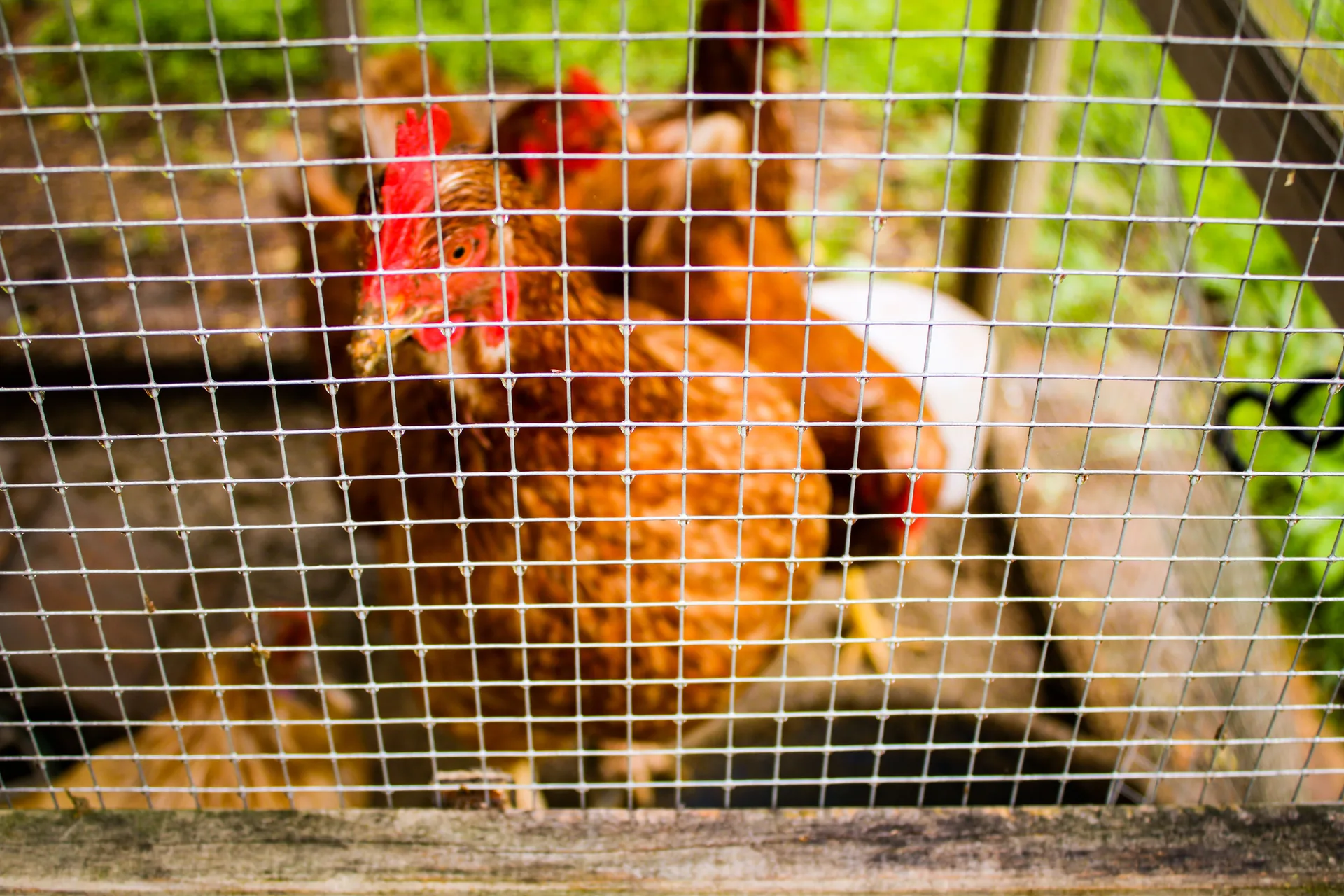
How to Predator-Proof a Chicken Coop: A Build Checklist
A predator-proof chicken coop checklist: half-inch hardware cloth, a buried apron, raccoon-proof latches, a solid floor, and a door that closes at dusk.
Researched from university extension, USDA, and veterinary sources. How we research.
A predator-proof chicken coop is not a coop with a strong lock. It is a coop where every opening is smaller than a weasel, every wall meets the ground in a way a fox cannot dig under, every latch takes two motions a raccoon cannot make, and the door is shut before the sun goes down. Get those four things right and the rest of predator control is housekeeping.
This is a build and retrofit checklist. It assumes you already know what is hunting your birds; if you are trying to figure that out from the evidence, start with our guide to chicken predators and how to identify them. Everything here applies whether you are building from plans, assembling a kit, or fixing the coop you have.
The Checklist
Print this and walk your coop at dusk with a flashlight.
- •Every vent, window, and gap covered with 1/2-inch hardware cloth, screwed and washered, not stapled.
- •No chicken wire anywhere a predator can reach.
- •A hardware cloth apron laid flat 12 inches out from the run walls, or the wall wire buried 12 inches down.
- •A solid floor, or hardware cloth under the floor, on any coop that sits on the ground.
- •Every door and nest box lid on a two-step latch or a carabiner, including the pop door.
- •The pop door closed at dusk, every night, by you or an automatic door.
- •The run covered, with wire or netting overhead.
- •Feed locked up at night and no spilled feed in the run.
- •Cover cleared for a few feet around the coop.
- •A walk-around check once a week for new holes, loose wire, and dig marks.
The rest of this guide explains each one and why it is there.
1. Half-Inch Hardware Cloth on Every Opening
Hardware cloth is welded, galvanized wire mesh. The 1/2-inch size is the standard for a reason: it stops a raccoon's hand, a weasel's body, and a rat, and it stands up to a dog's teeth. The University of New Hampshire's extension puts the rule simply: if you use wire mesh, make the openings smaller than one inch so predators cannot reach through. Half-inch does that with room to spare and also blocks most snakes and the mice that draw them.
Fasten it with screws and fender washers, or with a strip of wood lath screwed over the edge. Staples pull out. A raccoon that finds a lifted corner will work at it all night. Overlap sheets by an inch or two and wire the seams.
Windows and vents are where coops fail. The ventilation you need for healthy birds is also a hole, so every vent gets hardware cloth over it, from the inside if the cladding makes the outside awkward. See chicken coop insulation and ventilation for how much opening you need; the answer is more than most kit coops give you, and all of it needs covering.
2. No Chicken Wire
Chicken wire, the hexagonal stuff, keeps chickens in. It does not keep anything out. Raccoons tear it, dogs push through it, and the openings are big enough for a raccoon to reach in and pull a bird's head through, which Colorado State University's extension and others describe as a signature raccoon kill. Use it for interior partitions and nothing else. If your run is chicken wire, you do not need to tear it down; line the bottom 3 to 4 feet with hardware cloth on the outside and cover the rest with the overhead wire from step 7.
For a full comparison of wire types and what they cost, see chicken run fencing and netting.
3. An Apron or a Buried Wall
Foxes, coyotes, dogs, and skunks dig. Oklahoma State University's extension recommends burying the lower 12 inches of the run fence straight down. That works, and it is what most older guides say. The easier version, which most keepers have moved to, is an apron: a strip of hardware cloth about 12 to 24 inches wide attached to the bottom of the run wall and laid flat on the ground facing outward, pinned with sod staples or held under turf, pavers, or a few inches of gravel. A digging animal starts at the wall, hits wire, and does not think to back up two feet and start again.
An apron beats a trench because it takes an hour instead of a day, does not rust below grade as fast, and can be added to an existing run without moving anything. Colorado State's extension recommends buried hardware cloth or welded wire around the run perimeter where digging predators are a problem; the apron is the same principle laid flat.
4. A Solid Floor
A coop sitting directly on dirt is open from below to rats, snakes, weasels, and skunks. Colorado State's extension recommends raising the coop about a foot off the ground so those animals cannot take up residence underneath, and keeping the floor tight with every hole patched. If your coop is on the ground, staple hardware cloth to the underside of the floor frame before you set it, or lay a sheet across the footprint and build on top. Raised coops need the same treatment where the floor has gaps, and the space beneath should be either open enough to see into or closed off with wire.
Rats deserve a mention here because they do more than steal feed. Oklahoma State notes that mice and rats open the way for other predators by gnawing through structures and burrowing around buildings. Every rat hole is a weasel door. Our guide to keeping rodents out of chicken feed covers the feed side.
5. Raccoon-Proof Latches
Raccoons have hands. The University of Maryland's extension warns that raccoons are very intelligent and can open simple latches, and a hook-and-eye, a sliding barrel bolt, or a turn button is a puzzle they can solve. Plenty of keepers have found the coop door open in the morning and a raccoon inside. The fix is a latch that takes two separate motions:
- •A carabiner through the hasp. Cheapest and best. A spring-gate carabiner clipped through a hasp or a barrel bolt's staple cannot be opened by a paw.
- •A spring-loaded latch with a pin or padlock. The lock does not have to be locked; a padlock hanging open in the hasp is enough.
- •Two latches on large doors. One high, one low, so the door cannot be pried at a corner.
Do the same on nest box lids, which raccoons lift, and on the pop door. Check the hinges too: a door that latches but hangs on two loose screws opens from the other side.
6. Close the Pop Door at Dusk
This is the single most effective step on the list, and it is free. The University of New Hampshire's extension calls shutting chickens in at night "easily the most important and effective way of protecting free range birds," because most predators hunt between dusk and dawn. Colorado State says the same: train the birds to return to the coop every evening and keep it locked at night. Chickens put themselves to bed at dusk; all you have to do is close the door behind them.
The failure is not forgetting once; it is forgetting on the one night a raccoon checks. If you cannot be home at dusk every day of the year, an automatic coop door on a light sensor or timer solves it. Owls take birds at dusk and dawn, so the door should close at last light, not an hour after.
7. Cover the Run
Hawks hunt by day and owls by night, and neither needs a gap in the wall. Colorado State recommends covering the run with welded wire, chicken wire, or game-bird netting, or stringing a grid of crisscrossing wire overhead. Chicken wire is fine here, since nothing overhead is going to tear it; the job is to stop a bird dropping in, and to keep a climbing raccoon from coming over the top. A solid roof over part of the run adds shade and keeps the ground dry, which the hens will use more than you expect.
If you free-range by day and cannot cover the range, cover is the alternative: shrubs, a table, a pallet on blocks, anywhere a hen can duck under when the rooster screams. Roosters and geese both help spot hawks. Nothing stops a determined hawk in an open field except a fence overhead.
8. Lock Up the Feed
Feed left in the run overnight is bait. Colorado State lists eliminating food sources that draw nighttime visitors as a first step, and New Hampshire's extension recommends feeding only what the birds finish, storing feed in airtight containers, and cleaning spills promptly. Bring the feeder into the coop or a bin at night, or use a treadle feeder that closes when the hens step off. Rats come for feed, and raccoons and snakes come for rats.
9. Clear the Cover
Colorado State's extension recommends creating what it calls a predator-danger zone: leave the area around the coop and run free of brush, debris piles, and construction waste, because most ground predators are uncomfortable crossing open ground, and raccoons are less likely to work at a wire wall when they have to sit in the open to do it. Oklahoma State adds keeping grass and weeds cut short and thinning trees that give hawks and owls a perch. Put the shade shrubs inside the run where the hens can use them, not against the outside wall where a fox can.
A motion-activated light aimed at the run adds a little; Colorado State suggests one. Solar predator-deterrent lights, the kind with blinking red LEDs, get mixed reviews, and Oklahoma State's guidance is that repellents and scare devices are not effective long term. Treat lights as a supplement to wire, never a substitute.
10. Walk It Weekly
Wire rusts, staples lift, wood rots, and predators test the same spot every night until it gives. Once a week, walk the perimeter and look for dig marks along the apron, bent wire, gaps where the run meets the coop, and droppings. A coop camera pointed at the run will show you what is visiting and where it is working, which is the fastest way to find the weak spot.
Electric Fence: The Upgrade
If you keep birds on open ground, or if bears, coyotes, or persistent dogs are the problem, electric poultry netting is the step beyond wire. A charged net does not need to be dig-proof, because the animal gets shocked on the nose before it starts. It also moves, which fixed hardware cloth cannot. Our guide to the best electric fence for chickens covers chargers and netting.
Predator-Proofing a Kit Coop
Most prefab coops arrive with chicken wire, flimsy latches, and a floor you can see through. Before the birds move in:
- •Replace or cover every panel of chicken wire with 1/2-inch hardware cloth.
- •Add carabiners to every latch and nest box lid.
- •Staple hardware cloth across the bottom of the run frame and add an apron.
- •Screw the coop to the run; kit connections are often a few small bolts a dog can knock loose.
- •Anchor the whole thing so it cannot be tipped.
Our buyer's guide to chicken coops flags which kits need the least of this work.
Frequently Asked Questions
What is the best wire for a predator-proof chicken coop?
Half-inch galvanized hardware cloth, screwed on with washers. It stops raccoons reaching in, weasels squeezing through, and rats and snakes getting in. Chicken wire only keeps chickens in.
How deep should you bury wire around a chicken run?
Oklahoma State's extension recommends 12 inches straight down. An apron of hardware cloth laid flat 12 to 24 inches outward and pinned to the ground does the same job with far less digging.
Can raccoons open chicken coop latches?
Yes. Hooks, barrel bolts, and turn buttons are all within their ability. Use a latch that needs two motions, such as a carabiner clipped through the hasp or a spring latch with a pin.
Do I need to lock the coop at night if I have a fenced run?
Yes. The run wire is the first line, and the coop door is the second. Most attacks happen between dusk and dawn, and shutting the birds inside is the most effective single step according to extension services.
How do I predator-proof the top of a chicken run?
Cover it with welded wire, chicken wire, or bird netting, or string a grid of wire overhead. This stops hawks and owls and keeps climbing raccoons from coming over the wall.
Will a light keep predators away from my coop?
A little. Motion-activated lights help, but Oklahoma State's extension notes that scare devices and repellents are not effective long term. Wire and a closed door do the work; lights are extra.
Bottom Line
Half-inch hardware cloth on every opening, an apron at the base, a solid floor, two-motion latches, and a door that closes at dusk. That is the whole system. Everything else, from lights to guardian dogs to electric netting, is a layer on top of it, not a replacement for any part of it.
Sources:
- •Colorado State University Extension. Chickens and Predators (locking at night, raising the coop, small-mesh wire, burying hardware cloth, covering the run, clearing cover, lights). https://extension.colostate.edu/resource/chickens-and-predators/
- •Oklahoma State University Extension. Protecting Small Poultry Flocks from Predators (burying fence 12 inches, rodents, scare devices). https://extension.okstate.edu/fact-sheets/protecting-small-poultry-flocks-from-predators
- •University of New Hampshire Extension. What are the best ways to protect my chickens from predators? (openings under one inch, closing the coop at night, feed storage). https://extension.unh.edu/blog/2019/02/what-are-best-ways-protect-my-chickens-predators
- •University of Maryland Extension. Identifying and Preventing Poultry Predators in the Mid-Atlantic Region (raccoons open simple latches). https://extension.umd.edu/resource/identifying-and-preventing-poultry-predators-mid-atlantic-region-1
- •Poultry Extension (eXtension). Predator Management for Small and Backyard Poultry Flocks (identifying predators by the evidence). https://poultry.extension.org/articles/poultry-management/predator-management-for-small-and-backyard-poultry-flocks/
Related Guides
How to Build a Chicken Coop: Plans, Materials & Tips
Step-by-step guide to building your own backyard chicken coop. Covers sizing, materials, ventilation, predator-proofing, and common mistakes to avoid.
Gear ReviewsBest Chicken Coop Cleaning Tools and Supplies (2026)
The best chicken coop cleaning tools and supplies for backyard flocks: extendable poop scoopers, coop cleaner sprays, disinfectants, and odor eliminators.
Gear ReviewsBest Chicken Coop Fans for Ventilation (2026 Reviews)
The best chicken coop fans for summer heat and winter moisture: solar exhaust fans, shutter fans, and quiet inline fans compared, with real prices.
Gear ReviewsBest Predator Deterrent Lights and Alarms (2026)
Predator deterrent lights, motion sprinklers, and driveway alarms that keep raccoons, foxes, and coyotes away from your chicken coop at night.