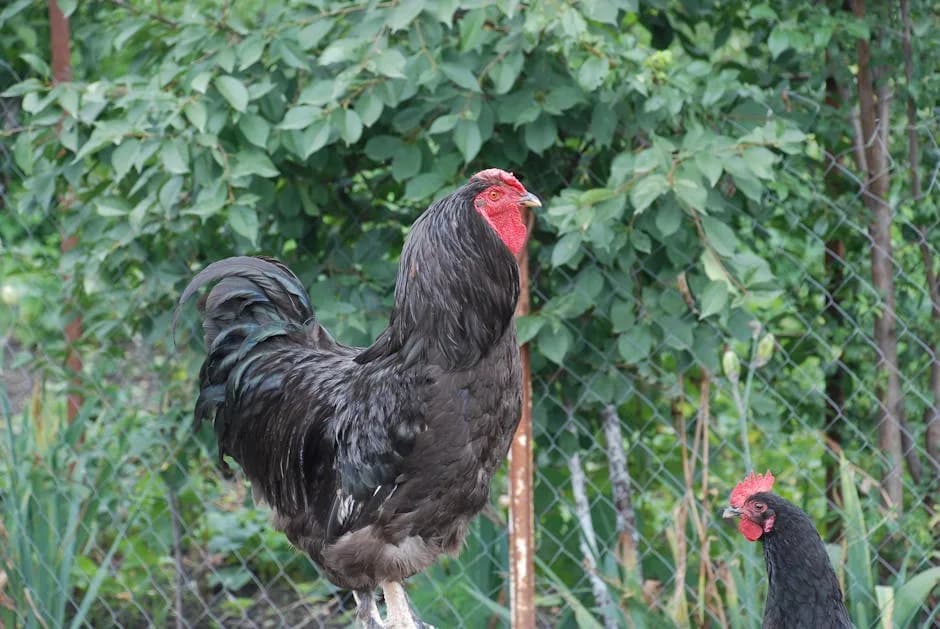
Rooster vs Hen: How to Tell the Difference
How to tell a rooster from a hen: comb and wattle size, hackle and saddle feathers, crowing, spurs, and behavior, plus the age each clue appears.
Researched from university extension, USDA, and veterinary sources. How we research.
A rooster is an adult male chicken and a hen is an adult female. They are the same species, so the difference is not a matter of breed or size but of sex, and you read it off a handful of physical and behavioral clues: comb and wattle size, the shape of the neck and back feathers, the tail, spurs, and whether the bird crows. Some of these show up in the first few weeks, others not until four or five months. The single clue that settles it every time is an egg. If the bird lays one, it is a hen.
Here is the fast version before we get into each clue.
| Feature | Rooster (male) | Hen (female) |
|---|---|---|
| Comb and wattles | Larger, redder, develop earlier | Smaller, paler, slower to develop |
| Hackle feathers (neck) | Long, narrow, pointed, shiny | Short, rounded at the tip |
| Saddle feathers (lower back) | Long, pointed, drape down the sides | Absent; back feathers stay rounded |
| Tail | Long curved sickle feathers | Shorter, straight feathers |
| Crowing | Yes, usually by 4 to 5 months | No (rare exceptions) |
| Spurs | Prominent, grow with age | Small nub or none |
| Legs and body | Thicker legs, taller, upright stance | Finer legs, more compact |
| Lays eggs | Never | Yes |
What You'll Learn
- •Rooster, Hen, Cockerel, Pullet: Getting the Terms Right
- •Comb and Wattles: The First Clue
- •Hackle Feathers on the Neck
- •Saddle Feathers on the Lower Back
- •Tail and Sickle Feathers
- •Crowing and Other Sounds
- •Spurs and Leg Size
- •Behavior Differences
- •At What Age Can You Tell?
- •Reliable Sexing Methods
- •Breeds That Are Hard to Sex
- •Frequently Asked Questions
Rooster, Hen, Cockerel, Pullet: Getting the Terms Right
People mix these words up constantly, so let's sort them out. A chicken is the animal, either sex, any age. Within that, the words split by sex and by age:
- •Rooster (also called a cock or cockerel in older and British usage): an adult male chicken.
- •Hen: an adult female chicken.
- •Cockerel: a young male, under one year old.
- •Pullet: a young female, under one year old. Our guide to what a pullet is covers this term in more detail, since it comes up a lot when you buy started birds.
So "chicken vs rooster vs hen" is really one category and two of its members. When someone asks whether their bird is a chicken or a rooster, what they mean is whether their chicken is male or female. That is the question the rest of this article answers.
One more word you will see when buying chicks: straight run. That means the chicks were not sexed, so the batch is roughly half male and half female. Sexed pullets have been sorted so you get females, though even professional sorting is not perfect. If you bought straight-run chicks, expect to be doing plenty of the guessing described below.
Comb and Wattles: The First Clue
The comb is the fleshy crest on top of the head. The wattles are the two flaps hanging under the beak. Both are usually the earliest visible difference.
In a rooster, the comb and wattles grow larger, thicker, and redder, and they get there sooner. A young male often shows a reddening, developing comb by 4 to 8 weeks while his sisters still have small, pale, yellowish combs. By the time the birds are a few months old the difference is usually obvious: the male's comb stands tall and turns bright red, and his wattles hang noticeably lower.
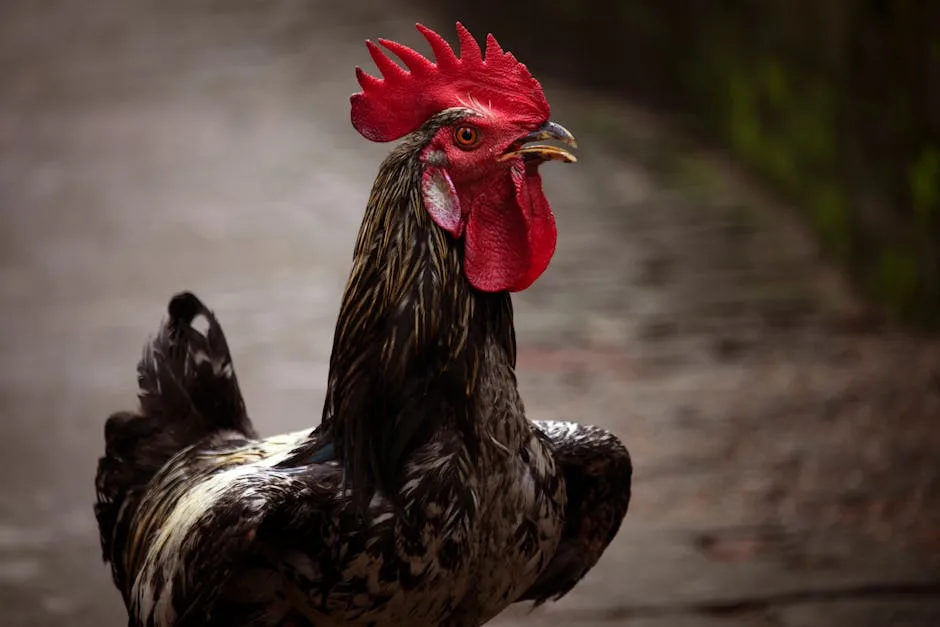
Two cautions. First, breed changes the baseline. Single-comb breeds like Leghorns show this difference dramatically, while rose-comb and pea-comb breeds are flatter in both sexes and harder to read. Second, comb color reddens in females too as they approach laying age, so a red comb by itself on a five-month-old bird does not prove it is male. Use comb size and how early it developed, not just color.
Hackle Feathers on the Neck
Hackle feathers are the feathers that cover the neck. This is one of the most reliable tells once a bird has its adult plumage, usually by 3 months and clearer by 5 or 6.
Look at the tip of a single neck feather:
- •Rooster hackles are long, narrow, and come to a pointed tip. They often have extra shine and drape down over the shoulders in a cape.
- •Hen hackles are shorter and rounded at the tip, with less shine.
A good way to see it is to catch the bird in good light and look at the feathers where the neck meets the shoulders. Pointed, streaming, glossy feathers mean male. Blunt, tidy, matte feathers mean female. This holds across most breeds and does not depend on comb type, which makes it one of the better clues for the pea-comb and rose-comb breeds that muddy the comb test.
Saddle Feathers on the Lower Back
The saddle is the area of the back just in front of the tail. This is a male-only feature and one of the clearest confirmations you can get.
Roosters grow saddle feathers: long, narrow, pointed feathers that stream down each side of the lower back toward the tail, sometimes almost to the ground on show breeds. Hens have no saddle feathers of this kind. Their back feathers stay short and rounded all the way to the tail.
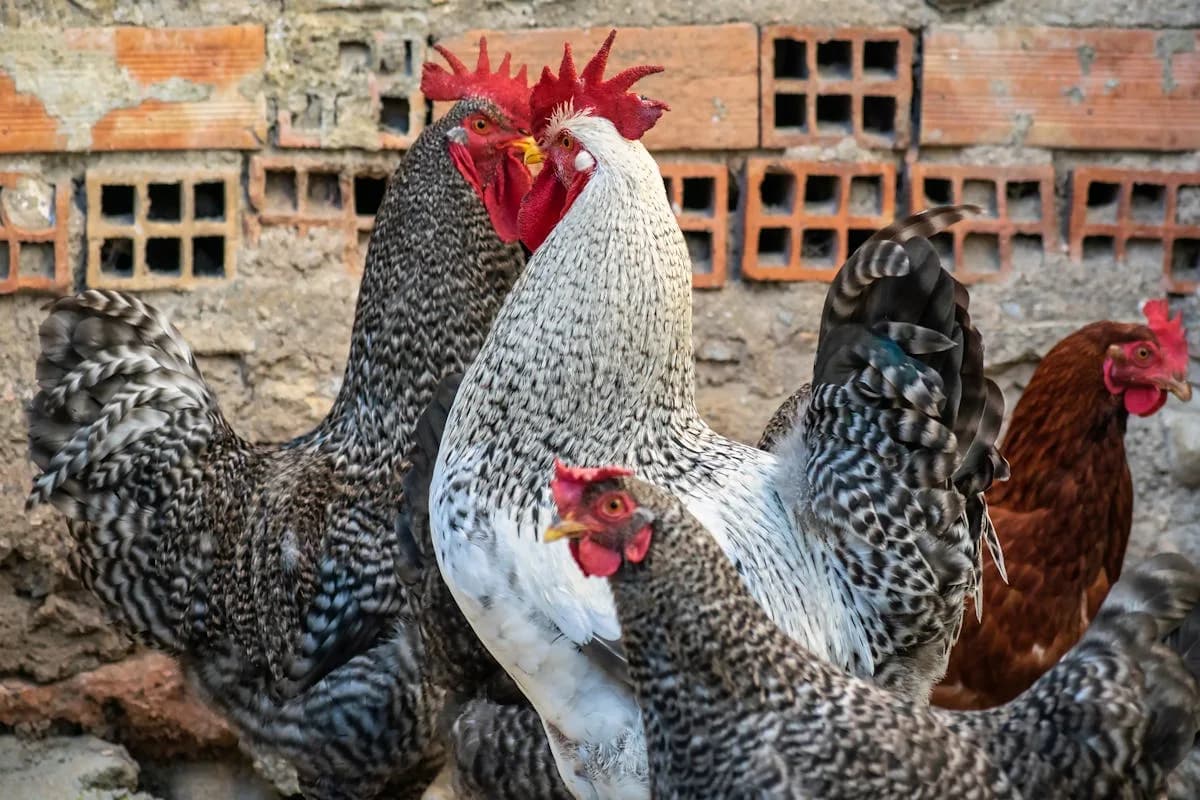
If you see those pointed, cascading feathers draping off the lower back, you are looking at a rooster. Saddle feathers usually finish coming in around 4 to 5 months, so this is a later clue than the comb but a very dependable one. Between the pointed hackles at the neck and the pointed saddle feathers at the back, a mature male has two unmistakable giveaways.
Tail and Sickle Feathers
The tail tells the same story. A rooster grows sickle feathers: the long, curved, glossy feathers that arc up and over the rest of the tail. They are the showy plumes people picture on a classic barnyard rooster. Hens keep a shorter, straighter tail with no dramatic curved plumes.
Young males start showing tail development a little before the sickles fully form, and the tail often sits higher and more upright than a hen's. As with saddle feathers, give it until 4 to 5 months for the sickles to be obvious. Note that during a heavy molt a rooster may temporarily drop his sickle feathers, so judge a bird in full feather, not mid-molt.
Crowing and Other Sounds
Crowing is the clue most people know, and it is close to definitive: if a chicken crows regularly, it is almost certainly a rooster. Cockerels usually start attempting to crow between 4 and 5 months, though some try earlier with a comical, cracking first attempt around 8 to 12 weeks. A rooster's crow is loud, repeated, and can happen at any hour, not just dawn.
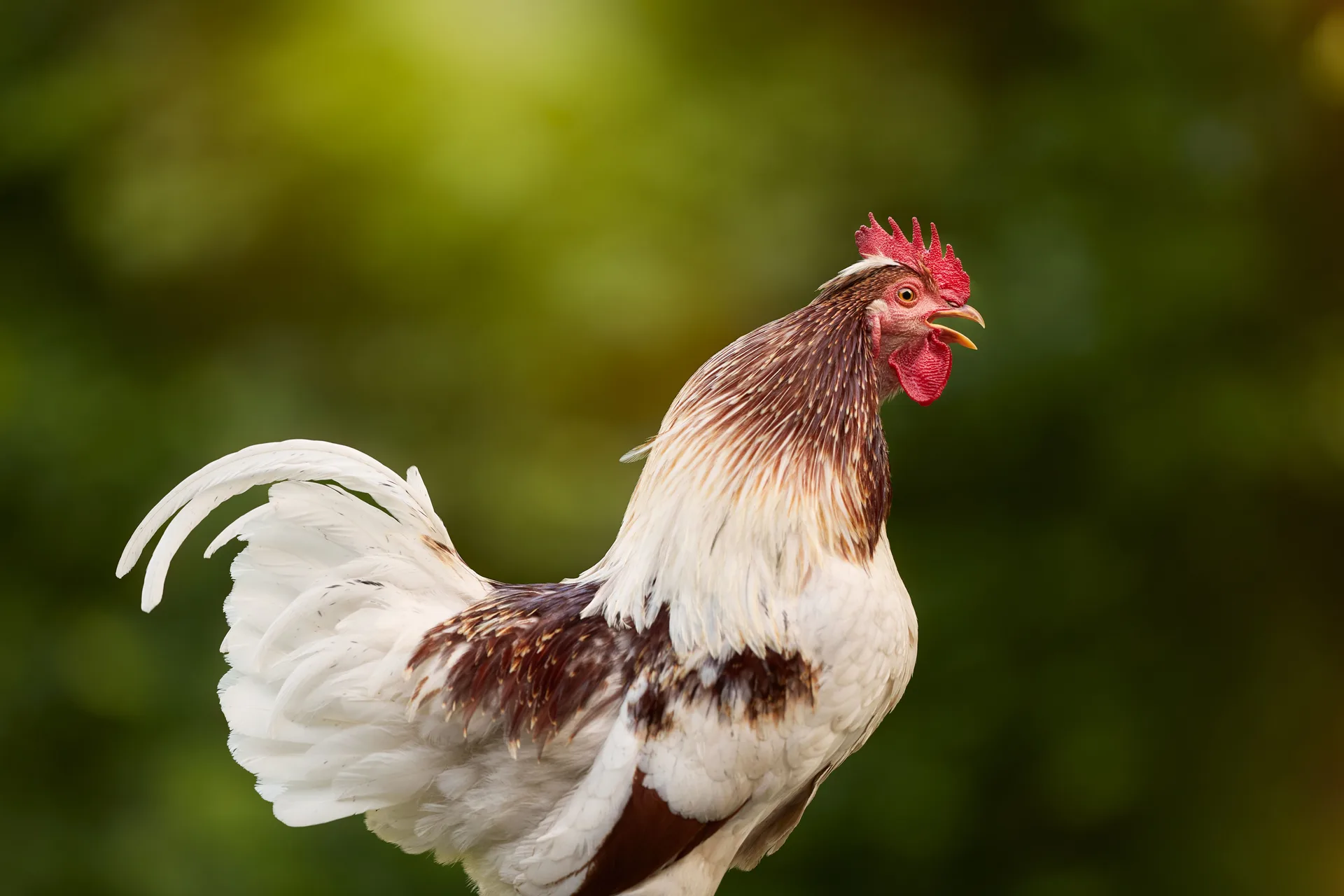
The catch: on rare occasions a dominant hen will crow, usually in a flock with no rooster where she steps into the leadership role. It is uncommon and the crow tends to be weaker, but it means crowing is a very strong clue rather than an absolute one. Hens have their own vocabulary, including the "egg song," a loud cackling burst around the time they lay. If your bird sings the egg song and you find an egg, that is a hen, full stop.
Spurs and Leg Size
Spurs are the pointed, bony projections on the back of the lower leg. Roosters grow prominent spurs that keep lengthening and sharpening with age. Young cockerels start with a small bump that becomes a real spur over the first year.
Hens usually have only a tiny nub or nothing at all, though this is where it gets tricky: older hens, especially after a few years, sometimes grow noticeable spurs. So a spurred bird is probably male, but a spur on an old hen is not unheard of. Treat spurs as supporting evidence, not proof on their own.
Legs and overall build help too. Roosters tend to have thicker, sturdier legs and bigger feet, stand taller, and carry themselves more upright with the chest out. Hens are generally more compact and hold a more horizontal posture. These are averages across a breed, so compare birds of the same breed and age rather than judging one bird in isolation.
Behavior Differences
Behavior often reveals a bird's sex before the feathers fully commit, especially if you watch a group of same-age youngsters together.
Signs pointing to a rooster:
- •Standing tall, chest out, keeping watch while others eat
- •Being first to challenge a new object, a hand, or another bird
- •"Tidbitting," where he finds food, makes a rapid clucking call, and invites others over
- •Sparring: chest-bumping and jumping at flockmates as the pecking order sorts out
- •Attempting to mount other birds
- •Sounding alarm calls at hawks overhead or sudden movement
Signs pointing to a hen:
- •The submissive squat, where the bird crouches low with wings slightly out (this also signals she is close to laying)
- •Staying lower to the ground and less confrontational
- •Spending more time foraging heads-down than standing sentry
None of these is foolproof on its own, since a bold pullet can act pushy and a mellow cockerel can lay low. But combined with the feather and comb clues, behavior fills in the picture. If you are deciding whether to keep a male at all, our guide on whether you need a rooster walks through the trade-offs, and how to care for a rooster covers what changes once you have one.
At What Age Can You Tell?
Timing is the part people find most frustrating, because the honest answer for most backyard breeds is "it depends, and earlier guesses are just guesses." Here is a rough timeline for a typical single-comb breed.
| Age | What you can usually tell |
|---|---|
| Day 1 | Nothing by eye for most breeds; only sex-links, auto-sexing breeds, and professional vent or feather sexing work this early |
| 3 to 4 weeks | Faint hints: some cockerels show a slightly larger, pinker comb, thicker legs, bolder behavior |
| 6 to 8 weeks | Comb and wattle size start to separate; earliest cracked crow attempts in a few males |
| 8 to 12 weeks | Combs clearly redder and larger on males; behavior differences stronger |
| 12 to 16 weeks | Pointed hackle feathers becoming visible; some males crowing |
| 16 to 22 weeks | Saddle feathers, sickle tail feathers, and regular crowing confirm males; pullets begin squatting and nearing their first egg |
By around five months the differences are usually settled for most breeds. If you are raising chicks and want the setup right from day one, see our brooder setup guide, and if you hatched them yourself, how to hatch chicken eggs covers the front end of that process.
Reliable Sexing Methods
If you cannot wait for feathers and crowing, there are ways to know earlier, with varying cost and accuracy.
Vent sexing. A trained professional turns the chick's vent to read the internal anatomy at day old. Commercial hatcheries use it, and skilled sexers reach roughly 90 to 95 percent accuracy. It takes real training and can injure a chick in inexperienced hands, so it is not a backyard technique.
Feather sexing. In lines bred for it, day-old chicks show a difference in the length of the wing feathers, with females having longer tips than males. This only works in breeds and crosses specifically developed for feather sexing, not chickens in general.
Sex-link crosses. These are hybrids bred so the two sexes hatch different colors, which makes them nearly 100 percent accurate to sort at hatch. The Black Sex Link is a well-known example, with males and females showing different down and later different adult coloring.
Auto-sexing breeds. A few purebreds carry a barring pattern that shows up as different chick down between the sexes, so you can sort them at hatch without crossing two breeds. The Cream Legbar and the Bielefelder are the classic examples, both prized partly for exactly this reason.
DNA sexing. A lab tests a feather or blood sample and reports the sex with very high accuracy. It costs money per bird and takes days, so keepers mostly use it for valuable or genuinely hard-to-sex birds rather than a whole batch of chicks.
Breeds That Are Hard to Sex
Some breeds resist every visual clue until they either crow or lay an egg. If you have one of these, patience is the only reliable tool.
- •Silkies are the classic headache. Their fluffy, hair-like feathers lack the stiff structure that makes pointed hackle and saddle feathers easy to read, their combs are lumpy and slow to develop, and they are quiet birds, so crowing comes late. Many Silkie keepers do not know for sure until a bird lays or crows at five to eight months.
- •Crested and bantam breeds in general are harder, since crests hide the comb and small size exaggerates how subtle the early clues are.
- •Rose-comb and pea-comb breeds blur the comb test because both sexes have low, flat combs, so lean on hackle and saddle feathers instead.
When a breed hides its clues, the two definitive signs stay the same for every chicken on earth: a rooster crows, and only a hen lays an egg. If you are waiting on that first egg, our guide to when chickens start laying gives you a realistic timeline.
Frequently Asked Questions
What is the difference between a chicken, a rooster, and a hen?
A chicken is the species, of either sex. A rooster is an adult male chicken and a hen is an adult female. Young birds under a year get their own names: a cockerel is a young male and a pullet is a young female. So a rooster and a hen are both chickens, just different sexes.
Can you tell a rooster from a hen at hatch?
Not by eye for most breeds. Day-old sexing relies on professional vent sexing, feather sexing in lines bred for it, sex-link crosses, or auto-sexing breeds like the Cream Legbar where the down color differs between the sexes. For a typical backyard breed, you wait for the comb, feathers, and behavior to develop over the first few months.
At what age can you finally be sure?
For most single-comb breeds the differences are clear by about 4 to 5 months, when saddle and sickle feathers come in and males start crowing. Some breeds, especially Silkies and crested types, can take until 6 to 8 months, sometimes not until the bird crows or lays.
Do you need a rooster for hens to lay eggs?
No. Hens lay eggs whether or not a rooster is present. A rooster only matters if you want fertile eggs to hatch chicks. Our article on whether you need a rooster covers the pros and cons of keeping one.
Do hens ever crow or grow spurs?
Occasionally, yes. A dominant hen in a flock with no rooster will sometimes crow, usually weakly. Older hens can also grow visible spurs after a few years. Both are uncommon, so crowing and spurs strongly suggest a male but are not absolute proof on their own.
What is the most reliable single clue?
An egg. Only a hen lays eggs, so a bird that lays is female with no doubt. Short of that, regular crowing is the strongest behavioral clue for a male, and pointed hackle plus saddle feathers are the strongest feather clues.
What are saddle and hackle feathers?
Hackle feathers cover the neck and saddle feathers sit on the lower back in front of the tail. On a rooster both are long, narrow, and pointed, and the saddle feathers drape down the sides. On a hen these feathers are shorter and rounded at the tip, and true saddle feathers do not appear. They are two of the most dependable ways to sex an adult bird.
Why is my Silkie so hard to sex?
Silkie feathers are soft and hair-like, so they never form the crisp pointed hackle and saddle feathers that give males away. Their combs develop slowly and their crowing starts late. Many keepers only find out for certain when a Silkie crows or lays its first egg, often at five to eight months.
Once you know what you are looking at, telling a rooster from a hen gets much easier: check the comb and wattles early, then watch the neck and back feathers, the tail, the spurs, and the behavior as the bird matures, and let crowing or that first egg settle any doubt. If you are still planning your flock, our roundups of the best breeds for beginners and how many chickens to start with will help you build it with the right mix of birds.
Sources:
- •University of Kentucky Cooperative Extension. Poultry, "Sexing Day-Old Chicks." https://poultry.extension.org/
- •Mississippi State University Extension. Backyard and Small Flock Poultry. http://extension.msstate.edu/
- •Penn State Extension. Small-Scale Poultry Production. https://extension.psu.edu/animals/poultry
- •University of Florida IFAS Extension. 4-H Poultry. https://edis.ifas.ufl.edu/
Related Guides
How to Care for a Rooster: A Complete Guide
How to care for a rooster: feeding, spur trimming, comb frostbite, hen ratios, taming, and health. A practical guide for backyard chicken keepers.
Beginner GuidesBroody Hen: Signs and How to Break It (or Hatch)
A broody hen sits on the nest and stops laying. Learn the signs, how to safely break broodiness in a few days, and when to let her hatch chicks.
Beginner GuidesDo You Need a Rooster? Pros, Cons, and What to Expect
Wondering if you need a rooster for your backyard chickens? Here are 7 pros and 6 cons to help you decide, plus tips on rooster-to-hen ratio.
Beginner GuidesDuck Eggs vs Chicken Eggs: Taste, Nutrition, Baking
How duck eggs compare to chicken eggs on size, taste, nutrition, and baking, plus whether raising ducks for eggs is right for your backyard.