Black Sex Link Chicken: Eggs, Size, Temperament & Genetics
The Black Sex Link is a Barred Rock x Rhode Island Red cross you can sex at hatch. Eggs per year, adult weight, temperament, and how the color trick works.
Researched from university extension, USDA, and veterinary sources. How we research.
The Black Sex Link is not a breed. It is a first-generation cross, almost always a Rhode Island Red rooster over a Barred Plymouth Rock hen, bred so that the chicks can be sorted by sex the moment they hatch. Females come out solid black and grow into black hens with a bit of red or gold at the neck. Males hatch with a white dot on the head and grow into barred roosters. Hatcheries sell the same cross as Black Star, Rock Red, or just "black sex link," and it is one of the most common brown-egg layers in American backyards for one reason: the hens lay a lot of big brown eggs and are easy to live with.
This guide covers what to expect from a Black Sex Link hen, how the genetics work, how she compares with the red sex links, and what to know before you buy.
Black Sex Link at a Glance
| Type | Hybrid cross, not a recognized breed |
| Usual parents | Rhode Island Red rooster x Barred Plymouth Rock hen |
| Other names | Black Star, Rock Red, Black Sex-Link |
| Hen weight | About 5 to 7 lb (hatchery figures vary) |
| Rooster weight | About 8 to 9 lb |
| Eggs per year | 200 to 300 depending on the source, large to extra-large brown |
| First egg | Often 18 to 22 weeks |
| Temperament | Calm, curious, tolerates confinement, good with people |
| Cold hardiness | Good; single comb can frostbite in hard freezes |
| Broodiness | Rare |
| Breeds true | No. Offspring of two sex links are not sex links |
How the Sex-Link Trick Works
Chickens do sex determination backward from mammals. The University of Kentucky's poultry extension explains it: a rooster carries two Z chromosomes (ZZ) and a hen carries one Z and one W (ZW), so the hen decides the sex of the chick. The barring gene that puts white bars on a Barred Rock's feathers lives on the Z chromosome. A Barred Rock hen has one copy. A Rhode Island Red rooster has none.
Cross them and every chick gets one Z from its father, which carries no barring. Male chicks get their second Z from the mother, and that one is barred, so cockerels are barred. Female chicks get the mother's W instead, which carries nothing, so pullets are not barred. In practice that means:
- •Female chicks hatch black all over, sometimes with a little rust on the chest.
- •Male chicks hatch black with a white or yellow spot on the top of the head, which is the barring showing through. As adults they are barred like their mother with some red bleeding through from their father.
The extension guide on sexing day-old chicks notes this is far more reliable than vent sexing, which even skilled hatchery workers only get right about 90 percent of the time. With a Black Sex Link, anyone can sort a box of chicks with near-perfect accuracy.
The catch is that the trick only works in the first generation. Breed a Black Sex Link hen to a Black Sex Link rooster and the barring and the black scatter across both sexes at random. If you want more Black Sex Links, you need Barred Rock hens and a Rhode Island Red rooster again.
Eggs
This is why people buy them. Black Sex Link hens lay large to extra-large brown eggs, and they lay a lot of them. The exact number depends on who you ask and how the birds are kept. Cackle Hatchery puts its Black Sex Links at 200 to 280 eggs a year. Myers Poultry advertises 280 to 300 under good conditions. Both are first-year figures in decent management; a backyard hen that goes through a full molt each fall will land toward the lower end, and a hen in her third year will lay noticeably fewer. See how many eggs a chicken lays a day for what those annual numbers mean week to week.
Two things to know:
- •They start early. Most Black Sex Link pullets lay by 18 to 22 weeks, and some earlier, which is typical of production hybrids.
- •They burn hot. Hybrids bred for heavy first-year production tend to slow down sooner and are more prone to reproductive problems past three or four years than slower heritage breeds. That is the trade for the eggs.
Size and Appearance
Hatcheries disagree on the numbers. Cackle lists hens at 6 to 7 lb and roosters at 8 to 9. Myers lists hens at about 5 lb and roosters at 8. The difference comes down to the parent strains each hatchery uses. Either way a Black Sex Link hen is a solid medium-heavy bird, bigger than a Leghorn, close to her Rhode Island Red father, and the cull roosters dress out at a worthwhile size.
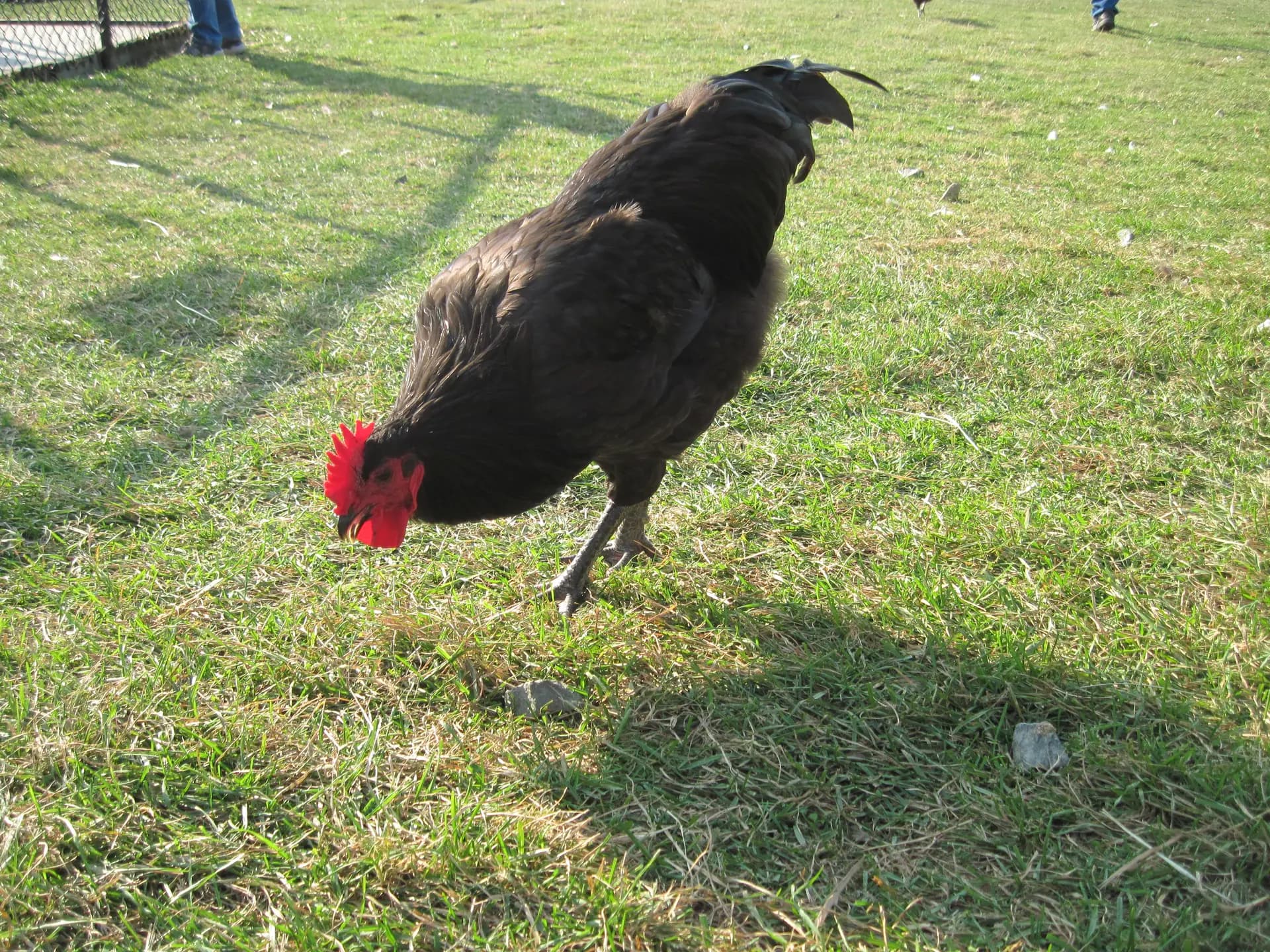
The hen is black with a green sheen in good light, usually with some copper or red feathers at the hackle and sometimes the breast. She has a single red comb, red wattles, yellow legs, and a compact body. Roosters are barred black and white, often muddied with red on the shoulders and hackle, and look a bit like a messy Barred Rock. The black feathering makes hens less visible to hawks than a white or buff bird, which is a small but real advantage for free-ranging.
Temperament
Black Sex Links are calm, curious, and confident without being pushy. They tolerate confinement well, which makes them a good fit for a fixed coop and run, and they forage actively when let out. Most are friendly toward people and easy to handle, especially if raised from chicks. In a mixed flock they tend to sit in the middle of the pecking order, neither bullies nor victims. Roosters vary, as roosters do; the Rhode Island Red side can produce an assertive cockerel, so watch a young male around children.
They are not particularly broody. A hen that goes broody is the exception, so if you want to hatch chicks under a hen, keep a Silkie or an Orpington for the job.
Climate
The parent breeds are both New England birds, and the cross handles cold well. The single comb is the weak point: in hard freezes with wind or damp, comb tips can frostbite. A dry, draft-free coop matters more than a heated one; see our guides to keeping chickens warm in winter and chicken coop insulation. In summer heat they cope about as well as any dark, medium-heavy bird, meaning shade and cool water are not optional.
Black Sex Link vs Red Sex Link
Both are sex-linked hybrids sold for eggs, and they overlap almost entirely on output. The differences are in the genetics and the look.
| Black Sex Link | Red Sex Link (Golden Comet, Cinnamon Queen, ISA Brown, Red Star) | |
|---|---|---|
| Sex-link trait | Barring gene | Silver and gold genes |
| Usual cross | Rhode Island Red rooster x Barred Rock hen | Red rooster (RIR or New Hampshire) x silver-factor hen (Rhode Island White, Delaware, White Rock, Silver Laced Wyandotte) |
| Female chick | Black | Red or buff |
| Male chick | Black with head spot | White or pale yellow |
| Adult hen | Black with red hackle | Red-brown with white flecks |
| Eggs | Large brown, 200 to 300 a year | Large brown, 250 to 320 a year |
| Size | Slightly heavier | Slightly lighter |
If you want the most eggs per pound of feed, red sex links like the ISA Brown and Cinnamon Queen edge ahead. If you want a bird that is a little heavier, a little calmer, and harder for a hawk to spot, the Black Sex Link is the pick. Many keepers run both. For a sex-link with a longer productive life and blue-grey feathers, look at the Sapphire Gem.
Buying Black Sex Links
Nearly every large hatchery carries them, and feed stores stock them every spring because they are cheap to produce and sell quickly. A few things to check:
- •Sexed pullets are the point. Because the chicks are color-sexed, hatchery sexing on this cross is nearly certain. If a seller offers "straight run" Black Sex Links, that is a straight run of the parent breeds' mixed offspring, not the same thing.
- •Ask what the cross is. Most use Rhode Island Red over Barred Rock. Some use a New Hampshire or a production red rooster, which changes size and egg count slightly. The University of Kentucky notes the black sex link can also come from a Barred Rock hen crossed with other non-barred roosters.
- •Started pullets are widely available. Because they are common, Black Sex Links are one of the easiest birds to find as 15 to 22 week started pullets if you want to skip the brooder.
Chicks need the usual brooder setup and starter feed for six weeks, grower until 18 weeks, and layer feed from there.
Frequently Asked Questions
What is a Black Sex Link chicken?
A hybrid made by crossing a Rhode Island Red rooster with a Barred Plymouth Rock hen. The chicks can be sexed by color at hatch, which is where the name comes from. It is sold as Black Star and Rock Red as well.
How many eggs does a Black Sex Link lay?
Hatchery figures run from 200 to 300 large brown eggs a year in the first laying year. Expect 4 to 6 a week at peak, fewer in winter and during the fall molt.
What color eggs do Black Sex Links lay?
Brown, usually medium to dark brown and large to extra-large.
Are Black Sex Links friendly?
Generally yes. They are calm, curious, and easy to handle, and they do well in a fixed run. Roosters vary in temperament.
How big do Black Sex Links get?
Hens run about 5 to 7 lb and roosters 8 to 9 lb, depending on the hatchery's parent lines.
Can you breed Black Sex Links?
You can, but the offspring will not be sex links. The color-sexing only works in the first generation from the Barred Rock and Rhode Island Red parents.
Black Sex Link vs Black Australorp?
They look alike as hens. The Australorp is a purebred that breeds true, lays around 250 to 300 eggs, and tends to live and lay longer. The Black Sex Link starts a bit earlier, is available sexed at hatch, and has copper at the hackle where the Australorp is pure black.
Bottom Line
The Black Sex Link is a working hen: sexed at hatch, laying by five months, and turning out large brown eggs at a rate few purebreds match. She is calm in a run, hardy in the cold, and cheap to buy. The trades are a shorter productive life than a heritage bird and no way to reproduce her at home. For a backyard flock that exists to fill an egg basket, she is hard to argue with.
Sources:
- •University of Kentucky, Animal and Food Sciences. Poultry: Sex-Linked Crosses (ZZ/ZW genetics, black sex-link from a barred hen and non-barred rooster). https://afs.mgcafe.uky.edu/poultry/sex-linked-crosses
- •Poultry Extension (eXtension). Sexing Day-Old Chicks (barring gene, head spot, vent sexing accuracy). https://poultry.extension.org/articles/poultry-management/sexing-day-old-chicks/
- •Cackle Hatchery. 4 Outstanding Dual-Purpose Sex Link Hybrid Chickens (cross, 6 to 7 lb hens, 8 to 9 lb roosters, 200 to 280 eggs). https://www.cacklehatchery.com/4-outstanding-dual-purpose-sex-link-hybrid-chickens/
- •Myers Poultry. Black Sex Link Chickens (280 to 300 eggs, 5 lb hens, 8 lb roosters). https://www.myerspoultry.com/product-black-sex-link
Image credit: Black Sex Link hen by CowboyNickA, CC BY-SA 3.0, via Wikimedia Commons.
Related Guides
Buckeye Chicken Breed Guide: Eggs, Size, Temperament
Buckeye chickens are a hardy, dual-purpose American breed with a pea comb. Learn their egg output, mahogany color, temperament, and cold-weather care.
BreedsBrahma Chicken Breed Guide: Size, Eggs, Temperament
Everything you need to know about Brahma chickens. Size, egg production (150-200/yr), temperament, 3 varieties, and care tips for these gentle giants.
BreedsLight Brahma Chicken: Size, Eggs, Color, and Care
The Light Brahma is the original gentle giant: a huge white, feather-footed bird that lays through winter. Learn its size, eggs, color, and care.
BreedsBuff Brahma Chicken: Size, Eggs, Color, and Care
The Buff Brahma is a gentle giant in golden feathers. Learn its size, egg laying, buff coloring, cold hardiness, and how to care for feathered feet.