Buff Brahma Chicken: Size, Eggs, Color, and Care
The Buff Brahma is a gentle giant in golden feathers. Learn its size, egg laying, buff coloring, cold hardiness, and how to care for feathered feet.
Researched from university extension, USDA, and veterinary sources. How we research.
If you want a backyard bird that turns heads, lays through the coldest months, and still eats out of your hand, the Buff Brahma is hard to beat. It is the golden version of the Brahma, one of the largest and calmest chickens you can keep, dressed in warm buff feathers with black trim at the neck and tail. People who meet one usually want one.
This guide covers what sets the Buff Brahma apart from the Light and Dark varieties, how big these birds actually get, how many eggs to expect, and the one chore that comes with all those feathers on their feet. If you are weighing the breed for a family flock, you will have a clear answer by the end.
Buff Brahma at a Glance
| Trait | Details |
|---|---|
| Variety | The buff variety of the Brahma breed |
| Size | Roosters 10-12 lb, hens 8-10 lb |
| Eggs | 150-200 per year, large, brown |
| Laying season | Keeps laying through winter |
| Temperament | Calm, gentle, friendly |
| Comb | Pea comb (resists frostbite) |
| Legs | Feathered shanks and feet, four toes |
| Cold hardy | Excellent |
| Heat tolerant | Poor to moderate |
| Broody | Moderately to strongly broody |
| Beginner friendly | Yes, with enough space |
| APA recognized | Buff variety admitted in 1924 |
| Lifespan | 5-8 years |
Quick Answer
The Buff Brahma is a large, feather-footed chicken with golden-buff plumage and black markings on the neck and tail. Hens weigh 8 to 10 pounds, roosters 10 to 12, and they lay 150 to 200 large brown eggs a year while keeping production going through winter when many breeds quit. They are calm enough for children, cold-hardy thanks to a tight pea comb and heavy feathering, and the main extra work is keeping their feathered feet out of mud. Color aside, they are cared for exactly like any other Brahma.
What You'll Learn
- •What Is a Buff Brahma?
- •What Does a Buff Brahma Look Like?
- •History: How the Buff Variety Came to Be
- •How Big Do Buff Brahmas Get?
- •Buff Brahma Temperament
- •How Many Eggs Do Buff Brahmas Lay?
- •Are Buff Brahmas Good for Beginners?
- •Housing and Space Requirements
- •Caring for Feathered Feet
- •Buff Brahmas in Cold and Heat
- •Buff Brahma vs Light, Dark, and Buff Orpington
- •Where to Buy and What to Watch For
- •Frequently Asked Questions
What Is a Buff Brahma?
A Buff Brahma is not a separate breed. It is one of the color varieties of the Brahma, the same way the Golden Laced and Silver Laced birds are both Wyandottes. The American Poultry Association recognizes three large-fowl Brahma varieties: Light, Dark, and Buff. All three share the same body type, the same feathered legs, the same pea comb, and the same gentle temperament. What changes from one to the next is the feather color and pattern.
So when you buy a Buff Brahma, you are buying a Brahma that happens to wear buff. Everything written about Brahma size, housing, feeding, and health applies to the buff bird without an asterisk. If you want the full breed background, our Brahma breed guide goes deep on the breed as a whole. This article stays focused on the buff variety: its coloring, its history, and the practical notes that matter most when you keep one.
The buff is the youngest of the three large-fowl varieties and tends to be the one people fall for on looks alone. A mature Buff Brahma hen in good feather, with fluffy golden legs, is a striking bird in a backyard full of ordinary brown hens.
What Does a Buff Brahma Look Like?
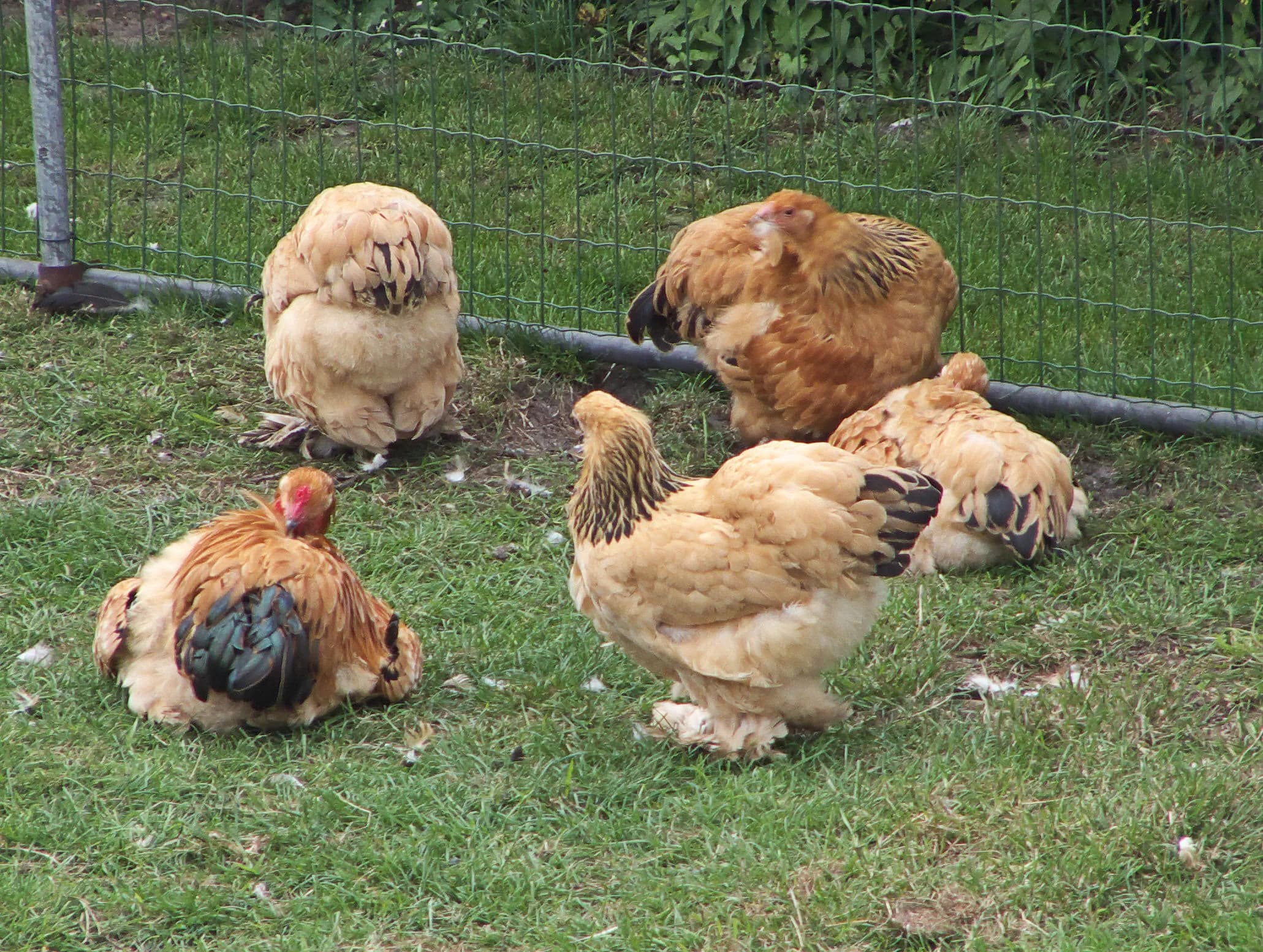
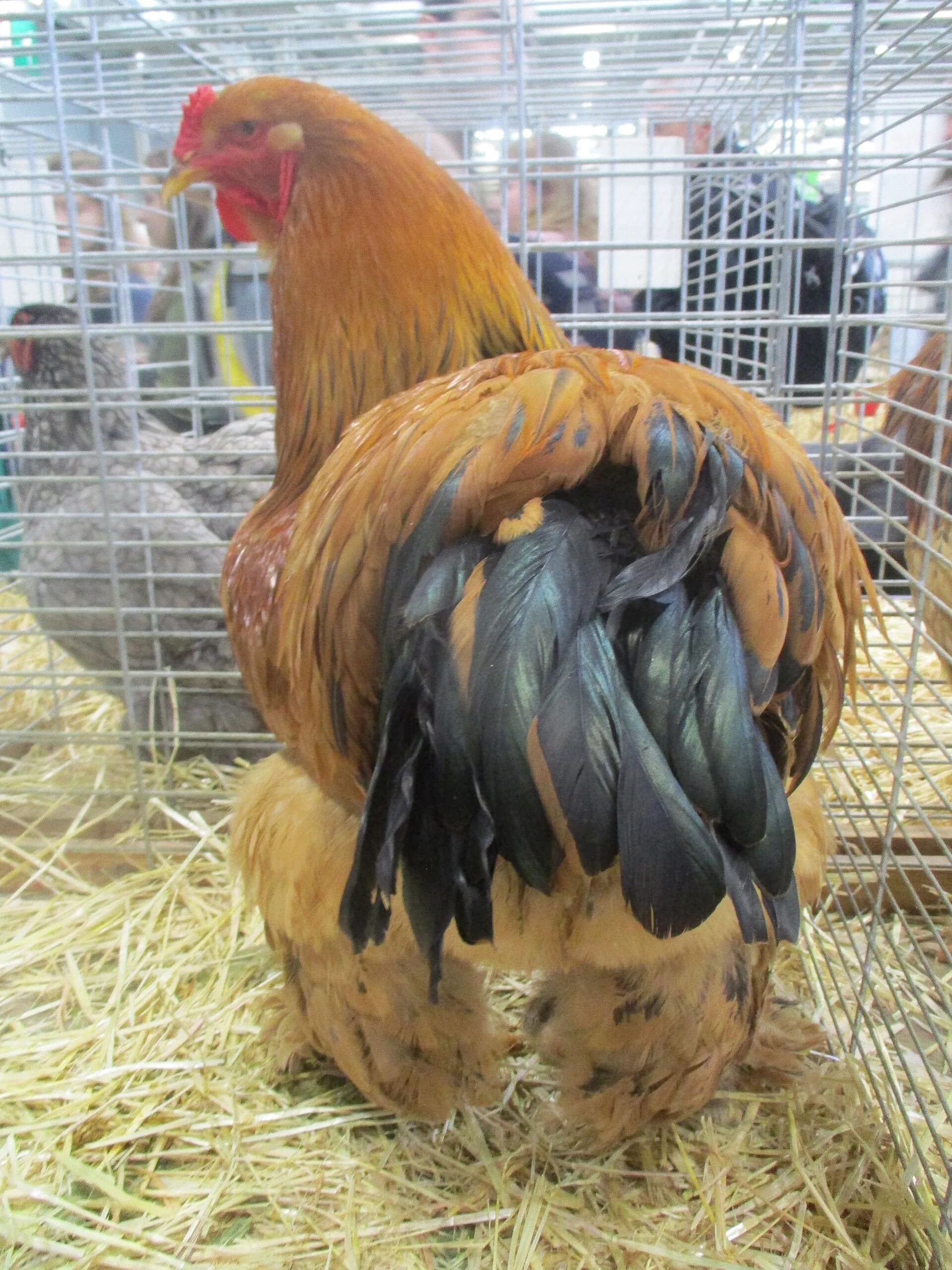
The base color is a rich, even golden-buff across the body, breast, back, and thighs. Against that warm background sit sharp black markings in two main places. The neck feathers, called the hackle, are black down the center with a buff edge, which reads as a striped collar when the bird holds its head up. The tail is black, most obviously in a rooster's long curved sickle feathers. There is also black in the wing flight feathers, though it mostly hides when the wing is folded, showing only as a dark bar when the bird stretches or flaps.
That layout, color restricted to the neck and tail with a clean body, is the same pattern the Light Brahma wears. The difference is simple: where the Light Brahma is white, the Buff Brahma is golden. Breeders sometimes describe it as a buff version of the Columbian pattern. Chicks hatch a soft creamy-buff with faint smudging and feather out to full color over several months.
Below the body, the Brahma hallmarks are all present:
- •Feathered shanks and feet. The legs carry feathers right down the outside of the shank and across the outer toes. This is the breed's signature look and also its one maintenance quirk.
- •Pea comb. A low, triple-ridged comb that sits close to the head. A small comb means very little surface area to freeze, which is a big reason Brahmas shrug off cold.
- •Four toes on each foot, yellow skin under the leg feathering, and red wattles and earlobes.
- •A deep, broad body carried on a wide stance, with a slight "beetle brow" over the eyes that gives the breed its thoughtful expression.
History: How the Buff Variety Came to Be
Brahmas came together in the United States in the mid-1800s from huge feather-legged birds imported through the port of Shanghai, the same Asian stock that gave us the Cochin. American and English breeders refined those imports into the Brahma we know, and the Light and Dark varieties were set first. They were among the breeds in the very first American Standard of Perfection.
The buff came later. Breeders worked buff coloring into the Light Brahma's neck-and-tail pattern, producing a golden bird that kept the Light's markings. The American Poultry Association admitted the Buff Brahma to its Standard in 1924, decades after the Light and Dark. That later arrival is why you will sometimes see the buff described as the "newest" Brahma color, even though the breed itself is a Victorian-era heritage fowl.
Two footnotes worth knowing, because they trip people up at the hatchery. The Buff Brahma Bantam, the miniature version, is a separate variety recognized later, in 1946. And the Buff Laced Brahma, a flashier bird with lacing across the whole feather, is a different and newer color that the APA has not recognized as a standard Brahma variety. More on that in the buying section.
How Big Do Buff Brahmas Get?
Big. Brahmas are routinely called "gentle giants," and the label is earned. A Buff Brahma rooster usually matures at 10 to 12 pounds, and large individuals push past that. Hens land around 8 to 10 pounds. On top of real body mass, the heavy feathering makes them look even larger, so a Buff Brahma rooster strutting across the yard can look closer to a small turkey than a chicken.
That size comes slowly. Brahmas are a slow-maturing breed, filling out their frame over the better part of a year rather than the few months a production hybrid takes. Pullets often do not start laying until 6 to 8 months, later than lighter breeds. Patience is part of the deal. The payoff is a long-lived, sturdy bird that stays productive for years rather than burning out early.
The size has practical knock-on effects. These birds are poor fliers and clumsy jumpers, which is handy for fencing but means roosts and ramps need to sit low. A heavy bird dropping off a tall roost onto hard ground can bruise a foot pad, which matters more on a feather-footed breed.
Buff Brahma Temperament
This is where the breed wins people over for good. Buff Brahmas are calm, slow-moving, and unusually tolerant of handling. They are not flighty, they rarely panic, and they are easy to pick up once they trust you. Families with kids gravitate to Brahmas for exactly this reason, and the breed shows up again and again on lists of the best chickens for beginners.
In a mixed flock, Brahmas tend to land in the middle or lower part of the pecking order despite their size. They are gentle enough that smaller, bolder breeds will sometimes boss them around, so watch that pushy bantams or Leghorns are not keeping a Brahma off the feeder. Give everyone enough space and feeder room and it usually sorts itself out.
Brahma roosters share the easygoing streak. Many keepers report Brahma cockerels among the most docile they have owned, which is no small thing for anyone in a suburban yard. That said, every rooster is an individual, and a big bird means a big spur, so the usual rules apply. If you are deciding whether to keep a male at all, our guide on whether you need a rooster walks through it.
How Many Eggs Do Buff Brahmas Lay?
Expect 150 to 200 large brown eggs a year from a healthy Buff Brahma hen. That is a fair layer, not a production machine. A Leghorn or a sex-link will out-lay a Brahma over a calendar year without much trouble. What the Brahma offers instead is timing.
Brahmas are known as winter layers. While many breeds slow down or stop entirely as daylight shrinks in late fall, Brahmas often keep eggs coming through the cold months. If you have ever watched your egg basket go empty in December, a couple of Buff Brahma hens can keep breakfast on the table when the rest of the flock takes the season off. The eggs themselves are large and brown, typically in the 55 to 60 gram range once a hen is in full lay.
Buff Brahmas also tend toward broodiness, moderately in many birds and strongly in some. A broody Brahma is a capable, committed mother, and her size lets her cover a generous clutch. There is one catch tied to those big feet: a heavy, feather-footed hen can crack or foul eggs in a tight nest. Give a sitting Brahma a roomy nest and a manageable number of eggs rather than a full dozen crammed under her. Our broody hen guide covers how to manage a hen that wants to sit, and how to break one that does not have fertile eggs to hatch.
If steady winter eggs plus the option to hatch your own replacements sounds ideal, the Buff Brahma also fits comfortably on a dual-purpose flock roster thanks to its heavy frame.
Are Buff Brahmas Good for Beginners?
Yes, with one condition: space. The temperament, the hardiness, and the forgiving nature make Buff Brahmas an easy first breed. They do not test fences, they do not spook easily, and they handle beginner mistakes better than high-strung birds. New keepers who start with Brahmas rarely regret it.
The condition is room. These are large birds, and cramming them into a coop sized for bantams causes trouble fast, from dirty feather-feet to pecking born of boredom. Plan for more square footage per bird than you would for a standard hen, both inside the coop and in the run. If you can give them space, a Buff Brahma is about as low-stress as backyard chickens get.
One honest expectation to set: you are not keeping these for maximum eggs. If your only goal is filling cartons as cheaply as possible, a lighter production breed does that better on less feed. Brahmas are for the keeper who wants a calm, beautiful, winter-laying bird and enjoys the animal as much as the egg.
Housing and Space Requirements
Size drives every housing decision with this breed.
- •Floor space. Aim for at least 4 square feet per bird inside the coop and 10 or more in the run, and lean toward the high end. Brahmas are big and they are home-bodies in bad weather, so they spend real time indoors in winter.
- •Low roosts. Set roosts lower than you would for athletic breeds, somewhere around 18 inches off the floor is plenty, and give a wide, flat perch (the edge of a 2x4 works well) so a heavy bird can rest its breastbone without gripping hard. A ramp up to the roost saves wear on feet and legs.
- •Wide doors and nest boxes. A full-grown Brahma is a wide bird. Oversized pop doors and roomy nest boxes, roughly 14 inches square, keep them from squeezing and keep eggs from getting stepped on.
- •Dry footing. This is the one that matters most for a feather-footed breed, and it gets its own section below.
Because they fly so poorly, Brahmas are easy to contain. A fence they could clear is often one they simply will not bother with. That makes them a good fit for open or low-fenced yards where a Leghorn would be over the top in a heartbeat. Good feeder and waterer setup matters too, since big birds drink a lot; see our picks for feeders and waterers and the full feeding guide for getting the ration right.
Caring for Feathered Feet
The feathered feet are the breed's beauty mark and its only real extra chore. Those leg and toe feathers look wonderful in dry conditions and turn into a problem in wet ones. Mud and droppings cake onto the foot feathering, and in freezing weather that wet mass can ball up with ice. Left alone it pulls on the skin, traps moisture against the foot, and can lead to sore or infected toes.
The fix is not fancy. It is dry bedding and a dry run.
- •Keep the coop floor and the area around the waterer dry. Deep, absorbent bedding helps; our rundown of coop bedding options compares pine shavings, straw, and sand for exactly this reason.
- •In a muddy run, lay down coarse material or give the birds a covered, dry patch to stand on.
- •If feet do cake up, soak the mud off in lukewarm water rather than pulling at frozen clumps, which can tear skin and feathers.
Feather feet also give scaly leg mites a place to hide. These mites burrow under the leg scales and raise them, leaving the legs crusty and rough. On a clean-legged breed you spot it early; under all that feathering it is easy to miss, so make a habit of parting the leg feathers and checking the scales every few weeks. Caught early it is straightforward to treat; our guide to the best mite treatments covers the options. None of this is hard, but it is the trade you accept for the look.
Buff Brahmas in Cold and Heat
Cold is where Brahmas shine. The combination of a small pea comb and a dense, heavy coat of feathers makes them one of the most cold-hardy breeds in the backyard. The pea comb barely freezes because there is so little of it exposed, and the plush feathering holds body heat through hard winters. This is a breed built for a northern flock, and their habit of laying through winter is part of the same package. Our winter chicken care guide and notes on keeping chickens warm apply, though honestly a Brahma needs less help than most.
The one winter watch-item is, again, the feet. Keep the ground under them dry so feather-feet do not ice up, and a Brahma will take a cold snap in stride.
Heat is the harder season for this breed. All that insulation works against them when the thermometer climbs, and a heavy, dark-footed, thickly feathered bird overheats faster than a lean breed. In hot climates or a brutal summer, give Buff Brahmas deep shade, plenty of cool water, and good airflow in the coop. Watch for panting and wing-holding on the worst days. They can live in warm regions, but they need more help staying cool than they ever need staying warm.
Buff Brahma vs Light, Dark, and Buff Orpington
Against the other Brahmas: The choice between Buff, Light, and Dark is almost purely cosmetic. All three are the same bird in size, temperament, egg laying, and care. Light Brahmas wear the same neck-and-tail black on a white body, Darks carry a fine gray penciling, and Buffs trade white for gold. Pick the color you like best and you have not given up anything on performance.
Against the Buff Orpington: This is the comparison people actually agonize over, since both are big, golden, gentle, and beginner-friendly. The quick version: the Buff Orpington is a solid buff all over with clean legs and lays a bit more generously year-round. The Buff Brahma is larger, has the black neck-and-tail trim, wears feathered feet, and edges out the Orpington on cold hardiness and winter laying. Want the easier-care clean leg and slightly better overall numbers? Orpington. Want the bigger, flashier, more cold-proof bird and do not mind the feather-foot upkeep? Brahma. You will not be unhappy with either.
Where to Buy and What to Watch For
Buff Brahmas are widely available as day-old chicks from the major US hatcheries, and most farm stores can order them even if they do not stock them during spring chick days. You can also find started pullets and adults from local breeders, which is a nice way to skip the brooder stage with such a slow-maturing bird.
Two things to confirm before you order, both from the history section:
- •Standard Buff Brahma vs Buff Laced Brahma. The Buff Laced Brahma is a different, newer color with lacing across the whole feather. It is popular and pretty, but it is not the APA-recognized buff variety. If you want the classic golden bird with black neck-and-tail trim described here, order "Buff Brahma," not "Buff Laced."
- •Large fowl vs bantam. The Buff Brahma Bantam is a separate, miniature variety. If you want the full-size gentle giant, make sure the listing says large fowl or standard, not bantam.
When your chicks arrive, expect slow, steady growth and do not worry when they feather out more gradually than hatch-mates from lighter breeds. Feed a good starter, keep the brooder clean, and give them time. A Buff Brahma is a bird you grow into over a year, and it pays that patience back for years after.
Frequently Asked Questions
Are Buff Brahmas good egg layers? They are fair layers, around 150 to 200 large brown eggs a year. The standout feature is that they keep laying through winter when many breeds stop, so they are valued more for steady year-round eggs than for peak numbers.
How big do Buff Brahma chickens get? Roosters typically reach 10 to 12 pounds and hens 8 to 10 pounds. Their heavy feathering makes them look even larger. They are one of the biggest backyard breeds and earn the "gentle giant" nickname.
Are Buff Brahmas friendly? Very. They are among the calmest, most handleable chickens you can keep, which makes them a favorite for families with children. Even the roosters are often notably docile.
What color eggs do Buff Brahmas lay? Large brown eggs, usually in the 55 to 60 gram range once a hen is in full production.
What is the difference between a Buff, Light, and Dark Brahma? Only the feather color and pattern. Buffs are golden with black neck-and-tail markings, Lights are white with the same markings, and Darks carry a fine gray penciling. Size, temperament, egg laying, and care are identical across all three.
Do Buff Brahmas go broody? Often, yes. Broodiness ranges from moderate to strong, and they make good, committed mothers. Give a sitting hen a roomy nest and a manageable clutch, since a heavy, feather-footed bird can crack eggs in a tight box.
When do Buff Brahmas start laying? Later than most. They are slow to mature and often do not lay until 6 to 8 months of age. The trade-off for the slow start is a long, productive life.
Are Buff Brahmas cold hardy? Excellent in cold. A small pea comb resists frostbite and the dense feathering holds heat, so they handle northern winters easily. The one cold-weather task is keeping their feathered feet dry so they do not ice up.
Sources
- •Oklahoma State University, Department of Animal and Food Sciences: Brahma Chickens, Breeds of Livestock
- •The Livestock Conservancy: Brahma Chicken
- •American Poultry Association: The American Standard of Perfection (variety recognition dates)
- •Merck Veterinary Manual: Mites of Poultry (scaly leg mite care)
Image credits: Buff Columbian Brahma pair by Rasbak, CC BY-SA 3.0; Buff Brahma rooster by Thomon, CC BY-SA 4.0. Both via Wikimedia Commons.
Related Guides
Light Sussex Chicken: Eggs, Color, Size, Care
Light Sussex chickens are white birds with a black necklace that lay 230-250 brown eggs a year. Full guide to looks, history, sex-linking, size, and care.
BreedsLavender Orpington Breed Guide: Eggs, Color, Care
Lavender Orpingtons are calm, cold-hardy hens that breed true to color and lay 150-250 brown eggs a year. Full guide to looks, eggs, care, and cost.
BreedsCinnamon Queen Chicken: Eggs, Color Sexing, Care
Cinnamon Queens lay 250-320 brown eggs a year and can be sexed by color at hatch. Full breed guide: looks, temperament, lifespan, and care.
BreedsSapphire Gem Chicken Breed Guide: Eggs, Care, Color
Sapphire Gem chickens lay 260-290 brown eggs a year and show off blue-grey plumage. Full breed guide: temperament, size, sexing, care, and where to buy.