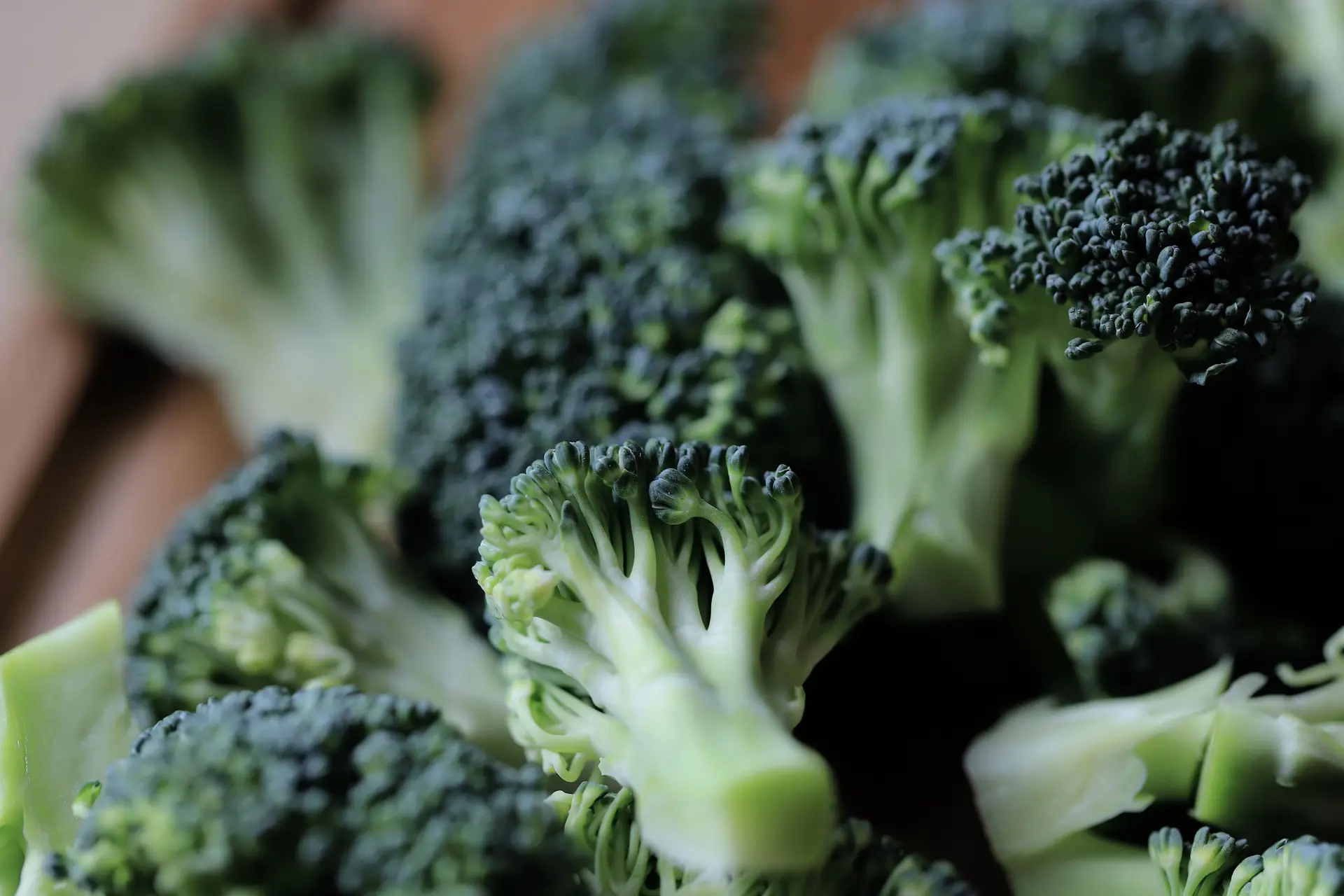
Can Chickens Eat Broccoli? Stems, Leaves, Raw or Cooked
Chickens can eat broccoli, raw or cooked, florets to stems. What the goitrogen worry actually amounts to, why a hanging head beats a pile, and how much to feed.
Researched from university extension, USDA, and veterinary sources. How we research.
Yes, chickens can eat broccoli, raw or cooked, and every part of it: florets, stems, leaves, and the tough base most people throw away. Broccoli is one of the more useful vegetable scraps a flock can get, high in fiber and protein for a vegetable and low in sugar, and a whole head hung in the run keeps a bored winter flock busy for an afternoon. The one question people ask, whether broccoli's goitrogens hurt a hen's thyroid, has a clear answer from the research, and it is no at any amount a backyard flock will eat.
This guide covers what broccoli offers, the goitrogen question, raw versus cooked, stems and leaves, how much to feed, chicks, and the hanging-head trick.
Is Broccoli Safe for Chickens?
Yes. Broccoli is not on the University of Florida's extension list of foods never to feed chickens, and its family, the brassicas, includes cabbage, kale, and cauliflower, all of which are common flock scraps. The only caution in the literature concerns glucosinolates, covered below, and it applies to concentrated feed ingredients, not to a head of broccoli.
What Is in Broccoli
USDA figures for raw broccoli put 100 grams at about 89 percent water, nearly 3 grams of protein, about 2.5 grams of fiber, under 2 grams of sugar, and a good deal of vitamin C, vitamin K, calcium, and potassium. For a vegetable scrap that is an unusually good profile: more protein than most greens, less sugar than any fruit, and fiber that keeps a hen's crop moving. Chickens make their own vitamin C, so that number matters less to them than to us, but the calcium is a small bonus for a layer.
Cooked broccoli loses some vitamin C and gains nothing, and it is softer, which matters for the stems.
The Goitrogen Question
Brassicas contain glucosinolates, and when the plant is chopped or chewed some of them break down into goitrin, which can interfere with the thyroid's use of iodine. This is real chemistry, and it is why poultry nutritionists limit canola meal, a brassica seed by-product, in commercial feed. A 2017 study in the Journal of Poultry Science found that broiler diets with 30 percent canola meal, carrying about 7 micromoles of glucosinolates per gram of feed, produced enlarged thyroids and slower growth, and the authors put the safe level for poultry diets under 2.5 micromoles per gram.
Broccoli is nowhere near that. A 2016 analysis in Nutrition Reviews measured goitrin in brassica vegetables and found that commercial broccoli, broccoli rabe, turnip tops, and most kale contain less than 10 micromoles of goitrin per 100-gram serving, which the authors called minimal risk, while collards, Brussels sprouts, and some Russian kale carry enough to matter for a person eating a lot of them. A 2024 systematic review in the International Journal of Molecular Sciences went further, concluding that most of the evidence casts doubt on the assumption that brassica vegetables have antithyroid effects at normal intake, that problems in animal studies appeared only with heavy feeding of kale and mustard, and that iodine supplementation reversed them. Cooking also deactivates the enzyme that makes goitrin.
Put together: a flock eating a head of broccoli a few times a week, on a layer feed that already contains iodine, is not at risk. A flock eating nothing but brassica greens for weeks would be a different question, and no flock should be eating nothing but any one scrap.
Raw vs Cooked Broccoli
Both are fine. Raw is more work for the hen and more entertainment; cooked is easier to eat and easier on a crop. Plain steamed or boiled broccoli, cooled, is a good use of leftovers. Broccoli in cheese sauce, butter, or a stir-fry is not, because of the salt and fat; salt is on the extension never list on its own. Frozen broccoli, thawed, is fine and cheap in winter.
Broccoli Stems, Leaves, and the Base
Stems are safe and are mostly fiber. Raw stems are hard for a hen to make progress on, so chop them into coins or cook them. Leaves, the big ones from a garden plant, are safe and among the greens hens like most; treat them like kale. The base, the woody stump, is safe but nearly inedible raw; hang it, boil it, or compost it. Flowering broccoli that has bolted in the garden is safe too, flowers and all.
The Hanging-Head Trick
Tie a string around the stem of a whole head, hang it in the run at chest height, and the flock will work at it for an afternoon without anyone hogging it or trampling it into the litter. It is one of the cheapest boredom-busters there is, and in winter, when the run is bare and feather-pecking starts, it earns its place. Take it down when it turns yellow and soft.
How Much Broccoli Can Chickens Eat?
Broccoli is filling, so a head for a flock of eight to twelve is plenty, a few times a week. Florets from a bag for a small flock, a handful per bird. The extension guideline for all treats combined applies: scraps and scratch together should be no more than the flock finishes in about 20 minutes, with a hanging head as the exception that is meant to last longer.
Signs of too much are the usual: hens skipping feed at the next meal and a slow drop in eggs, plus greener droppings, which are harmless.
Can Baby Chicks Eat Broccoli?
After the first couple of weeks on starter feed, finely chopped florets are a fine first green, and chicks like the texture. Keep the pieces tiny, the amount to a pinch, and chick grit in the brooder. Skip raw stems for chicks. See the brooder setup guide.
Broccoli in the Garden
A flock in a brassica bed eats the leaves and leaves the stems, which kills the plants. Keep chickens out from transplant to harvest, then let them clean up the leaves and stumps. Broccoli plants that have been sprayed for cabbage worms need the label's interval before the flock gets the trimmings.
Broccoli vs Other Greens
| Green | Protein per 100 g | Sugar | Fiber | Notes |
|---|---|---|---|---|
| Broccoli, raw | About 2.8 g | 1.7 g | 2.6 g | Hang the whole head |
| Kale, raw | About 2.9 g | 1 g | 4.1 g | The green with the most goitrin, still fine in a mix |
| Cabbage, raw | About 1.3 g | 3.2 g | 2.5 g | Hangs and lasts for days |
| Celery | 0.7 g | 1.3 g | 1.6 g | Chop the strings |
| Carrots | 0.9 g | 4.7 g | 2.8 g | Grate or cook |
Frequently Asked Questions
Can chickens eat raw broccoli?
Yes. Raw florets are fine; raw stems are hard for a hen and should be chopped or cooked. A whole raw head hung on a string is the classic way to feed it.
Can chickens eat broccoli stems and leaves?
Yes. Both are safe. Chop the stems into coins or cook them, and feed the leaves like kale.
Is broccoli bad for chickens because of goitrogens?
No, at any amount a backyard flock will eat. Broccoli is a low-goitrin brassica, the thyroid effects in poultry studies came from concentrated canola meal at levels far above what a head of broccoli delivers, and layer feed supplies iodine. Cooking deactivates the enzyme involved anyway.
Can chickens eat cooked broccoli?
Yes, plain and cooled. Not broccoli cooked with cheese, butter, salt, or sauce.
Is broccoli good for chickens?
It is one of the better vegetable scraps: high in fiber, protein, and calcium for a vegetable, and low in sugar.
Can baby chicks eat broccoli?
After two weeks or so on starter, finely chopped florets with chick grit available. Skip the stems.
Bottom Line
Broccoli is safe from floret to stump, better for a hen than most scraps, and the goitrogen worry does not survive contact with the research. Hang a head for a bored flock, chop the stems, and keep the cheese sauce for yourself. For the full list of what chickens can and cannot eat, see what can chickens eat.
Sources:
- •USDA FoodData Central. Broccoli, raw (SR Legacy, FDC ID 170379); Kale, raw (168421); Cabbage, raw (169975). https://fdc.nal.usda.gov/food-details/170379/nutrients
- •Felker P, Bunch R, Leung AM. Concentrations of thiocyanate and goitrin in human plasma, their precursor concentrations in brassica vegetables, and associated potential risk for hypothyroidism. Nutrition Reviews 2016 (broccoli under 10 micromoles goitrin per 100 g serving). https://pubmed.ncbi.nlm.nih.gov/26946249/
- •Do Brassica Vegetables Affect Thyroid Function? A Comprehensive Systematic Review. International Journal of Molecular Sciences 2024. https://pmc.ncbi.nlm.nih.gov/articles/PMC11012840/
- •Evaluation of Different Levels of Canola Meal on Performance, Organ Weights, Hepatic Deiodinase Gene Expression and Thyroid Morphology in Broiler Chickens. Journal of Poultry Science 2017 (glucosinolates under 2.5 micromoles per gram of poultry feed). https://pmc.ncbi.nlm.nih.gov/articles/PMC7477266/
- •UF/IFAS Extension Holmes County. 10 Foods You Should Never Feed Chickens (salt; broccoli is not on the list). https://blogs.ifas.ufl.edu/holmesco/?p=28475
- •Poultry Extension (eXtension). Feeding Chickens for Egg Production in Small and Backyard Flocks (the 20-minute rule for scraps). https://poultry.extension.org/articles/feeds-and-feeding-of-poultry/feeding-chickens-for-egg-production/
Related Guides
Can Chickens Eat Carrots? Raw, Cooked, Tops, and Peels
Chickens can eat carrots raw or cooked, tops included. Why raw carrots need grating, what beta-carotene does and does not do for yolks, and how much to feed.
Feed & NutritionCan Chickens Eat Potatoes? Cooked Yes, Green or Raw No
Chickens can eat plain cooked potatoes. Green, sprouted, and raw ones are the problem: solanine, and starch that barely digests. Peels, sweet potatoes, amounts.
Feed & NutritionCan Chickens Eat Rice? Cooked, Raw, and the Swelling Myth
Chickens can eat rice, cooked or uncooked, and the myth that dry rice swells and hurts birds is false. What rice offers, brown vs white, and how much.
Feed & NutritionCan Chickens Eat Blackberries? Berries, Leaves, and Canes
Chickens can eat blackberries, the lowest-sugar berry a flock gets. Leaves and canes, purple droppings, frozen and wild berries, and how many to feed.