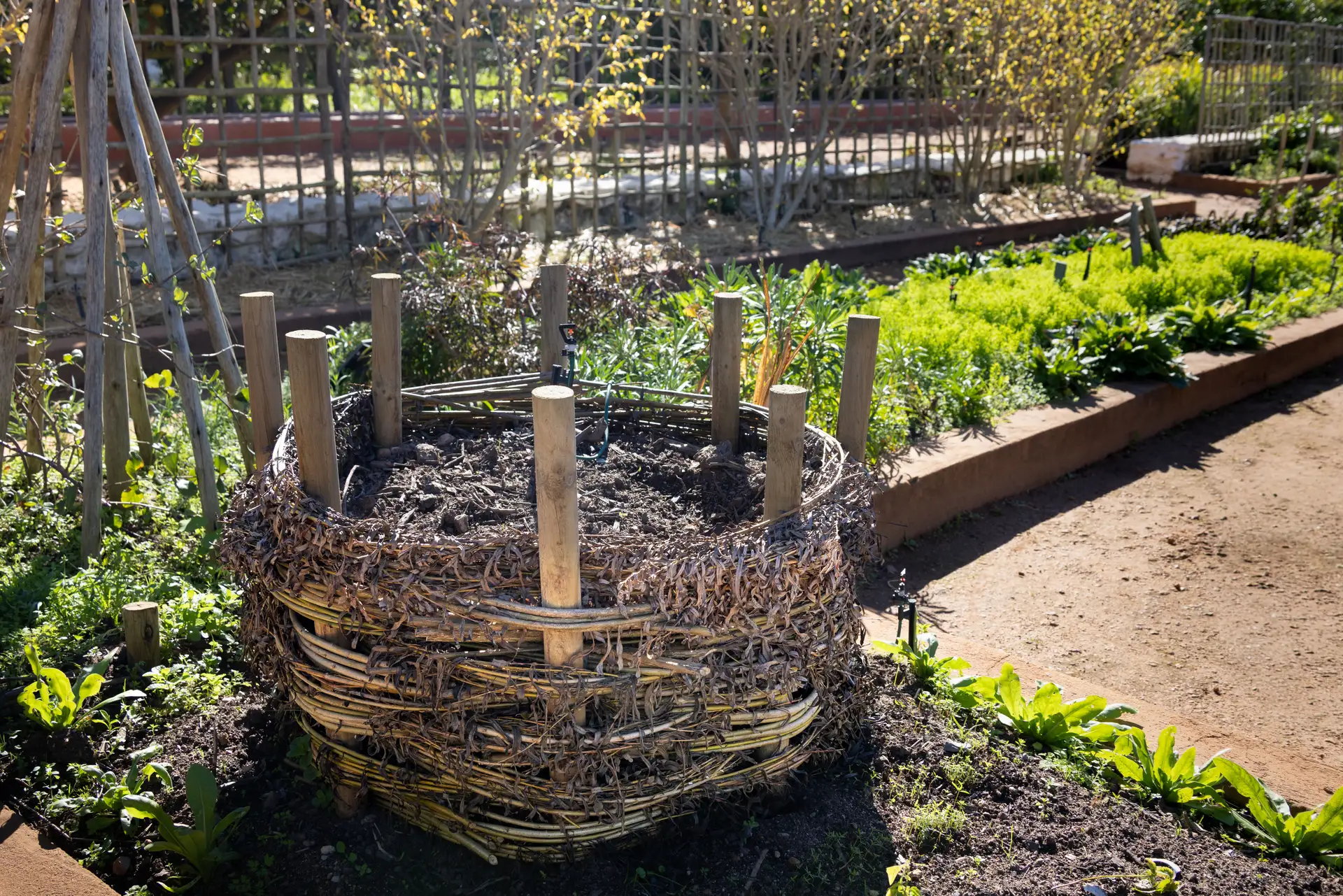
Best Compost Bin for Chicken Manure (And How to Compost It)
The best compost bins for chicken manure, from a $36 wire ring to dual-chamber tumblers, plus the temperatures, ratios, and waiting periods that make it safe.
Researched from university extension, USDA, and veterinary sources. How we research.
The best compost bin for chicken manure is the one big enough to get hot. That is the whole problem with composting coop cleanouts: chicken manure is the richest nitrogen source most gardeners will ever handle, extension services warn that it burns plants and carries pathogens if it goes on raw, and the fix for both is a pile that reaches 130 degrees or more and stays there. A pile that small bins cannot build. So the guide below starts with what the manure needs, then picks bins that deliver it, from a 36-dollar wire ring that makes a proper 4-foot pile to dual-chamber tumblers for a few hens on a small lot. Prices on the buttons come from Amazon and refresh twice a day.
Why Chicken Manure Has to Be Composted
Three reasons, all from the extension services.
It burns. Chicken manure is called "hot" for its nitrogen. Penn State Extension's guide to manure in home gardens notes the nitrogen may burn tender seedlings and says it should be composted before use, and an extension answer on chicken waste puts it more bluntly: raw chicken manure fertilizer can burn and even kill vegetable plants.
It carries pathogens. The same extension answer notes that proper composting generates temperatures of 140 to 160 degrees, enough to kill most human and animal pathogens such as E. coli and Salmonella. The USDA's organic rule puts numbers on it for certified growers, and those numbers are the best benchmark a backyard keeper has: composted manure must reach 131 to 170 degrees for 3 days in an enclosed or aerated pile, or for 15 days in a turned pile with at least five turnings. Raw manure that is not composted may only go on food crops 120 days before harvest if the edible part touches the soil, or 90 days if it does not. Those windows are the reason "just spread it in the fall" is the traditional advice: fall application to a bed harvested the following summer clears 120 days easily.
There is a lot of it. The poultry extension service's guide for urban flocks gives the arithmetic: a hen eats about a quarter pound of feed a day, fresh manure weighs about 115 percent of the dry feed eaten, and it is 75 percent water, so a six-hen flock produces roughly 1.7 pounds of wet manure a day. Kept dry in the litter, about a third of that weight remains. The University of Georgia's nutrient management guide puts a commercial layer at 20 to 30 pounds of manure a year on a dry basis. Either way, a bin sized for kitchen scraps fills in weeks.
What a Chicken Manure Compost Pile Needs
The University of Georgia published a composting guide written specifically for backyard poultry litter, and its numbers are the ones to build around.
- •Ratio. About three parts brown, carbon-rich material to one part green, nitrogen-rich material by volume: 70 to 75 percent carbon, 25 to 30 percent nitrogen. Coop litter helps here, because pine shavings or straw come out of the coop already mixed with the manure. Add dead leaves, straw, or shredded paper to get to 3 to 1. The USDA organic standard frames the same target as a starting carbon-to-nitrogen ratio between 25 to 1 and 40 to 1.
- •Size. Georgia's bins are 4 to 5 feet long, wide, and high, or 4 to 5 feet across for a round bin. That is the volume needed to hold heat. A pile much smaller than a cubic yard warms and cools with the weather instead of cooking.
- •Moisture. Uniformly moist throughout, about half the pile's weight, but not dripping. A squeezed handful should feel like a wrung-out sponge.
- •Temperature. Aim for an internal temperature of 130 to 150 degrees, and Oregon State's extension expects a well-built pile to reach 130 to 160 within 24 to 36 hours. Buy a long-stem thermometer; it is the only way to know.
- •Turning. Georgia's three-bin schedule is two weeks in the first bin, then turn it into the second for several more weeks, then into the third to mature. Oregon State's rule for a single pile is to turn it again whenever the temperature drops below 110 degrees, and to call it finished when it no longer reheats after moistening and turning.
- •Time. Several weeks of hot composting plus a curing period; most backyard piles are ready in two to three months in warm weather and longer in winter. Penn State's cited New Hampshire guidance is that the pile must hold high temperature for several weeks and be turned so every part of the manure has been exposed to it.
One more thing the extension answer flags: manure from laying hens can raise soil pH because of the calcium in their feed, so if your beds already run alkaline, test before you spread finished compost every year.
The Best Compost Bins for Chicken Manure
1. Geobin 246 Gallon Expandable Bin (Best Overall)
The Geobin is a roll of perforated plastic that clips into a ring up to about 4 feet across, which makes it the cheapest way to build the 4-to-5-foot pile Georgia's guide calls for. It holds a whole deep-litter cleanout, it breathes on every side, and when the pile is done you unclip it, lift it off, and set it up beside the finished heap to start the next one. Buy two and you have Georgia's turn-it-into-the-next-bin system for under a hundred dollars. Made in the USA, weighs 7 pounds, and it will outlast most plastic bins because there is nothing to crack.
The trade is that it is a ring, not a box: no lid, so rain gets in, and no floor, so rats can tunnel under a pile that is not turned. Both are manageable with a tarp and a regular turning schedule.
Check Price on Amazon: Geobin 246 Gallon Compost Bin$35.99 as of Oct 22
2. FCMP Outdoor IM4000 Dual Chamber Tumbler (Best Tumbler)
A tumbler is the answer for a small lot, a homeowners association, or a keeper who will not turn a pile with a fork. The IM4000 is the one that has been around longest: two 18.5-gallon chambers, so one side cooks while you fill the other, a body of recycled plastic, and a frame that stands up to a full load. At 37 gallons total it holds the weekly droppings from a small flock plus kitchen scraps and browns, not a full coop cleanout.
Tumblers run hotter than their size suggests because the black plastic holds heat and every turn aerates the whole batch, but a batch this small will not hold 130 degrees for the 15 days the USDA windrow standard asks; treat tumbler compost as needing a longer cure before it goes on food crops, or use the 120-day planting rule.
Check Price on Amazon: FCMP Outdoor IM4000 Dual Chamber TumblerThat listing is currently unavailable, so this opens an Amazon search for it.
3. VIVOSUN 43 Gallon Dual Chamber Tumbler (Best Budget Tumbler)
The same idea at about half the price, with slightly more volume, a metal frame, deep internal fins that break up clumps, and a pair of gloves in the box. The plastic is thinner than the FCMP's and the doors are the part that wears, but for a flock of three or four hens it does the job. VEVOR sells a near-identical 43-gallon unit for a little less if the VIVOSUN is out of stock.
Check Price on Amazon: VIVOSUN 43 Gallon Dual Chamber Tumbler$67.99 as of Oct 22
4. Goplus 80 Gallon Compost Bin (Best Enclosed Bin)
A lidded plastic box, 23 by 23 by 32 inches, with vents on every side and a hatch at the bottom to pull finished compost from. It keeps rain off, keeps the pile out of sight, and holds about twice what a tumbler does, so it swallows a partial cleanout. The catch is the size: 80 gallons is under half a cubic yard, so it will warm but rarely hit the 130-plus that a Geobin pile will. Use it for the steady weekly droppings and let a bigger pile handle the deep-litter dump, or run two side by side.
Check Price on Amazon: Goplus 80 Gallon Compost Bin$52.99 as of Oct 22
5. MTB Wire Compost Bin (Best for a Three-Bin System)
Four powder-coated wire panels that pin together into a 30-inch square, 24 inches tall, with no tools. One is small for a hot pile; three in a row, with the panels shared between bins, is the classic turning system Georgia describes at a fraction of the cost of pallets and hardware, and the open wire gives more air than any plastic bin. Buy three, stack the pile taller than the panels, and cover with a tarp in wet weather.
Check Price on Amazon: MTB Wire Compost BinThat listing is currently unavailable, so this opens an Amazon search for it.
6. Reotemp 20 Inch Compost Thermometer (Buy This With Any Bin)
None of the temperature numbers above mean anything without a thermometer, and a kitchen probe does not reach the middle of a pile. The Reotemp is a 20-inch stainless stem with a dial marked in the three zones that matter, made by a company that has built thermometers since 1965. Push it into the center of the pile every few days and write the number down; when it drops below 110, turn.
Check Price on Amazon: Reotemp 20 Inch Compost Thermometer$23.99 as of Oct 22
Which Bin for Which Flock
| Flock and setup | Bin | Why |
|---|---|---|
| 3 to 6 hens, small lot or HOA | Dual-chamber tumbler | Closed, tidy, no turning with a fork; cure longer before food crops |
| 6 to 12 hens, a yard | Geobin ring, two of them | Makes the 4-foot pile that actually gets hot; cheapest per gallon |
| Deep litter, once or twice a year cleanouts | Geobin or a three-bin wire setup | Holds a whole cleanout at once |
| Steady droppings board scrapings | 80-gallon lidded bin | Rain-proof, rodent-resistant, out of sight |
| Any of the above | Add a thermometer | The pile is only safe if it hit the numbers |
How to Compost Chicken Manure, Step by Step
- •Collect litter and manure. Coop cleanouts, droppings board scrapings, and the run's wet spots. If you use the deep litter method, the whole cleanout goes in at once.
- •Add browns to reach 3 to 1. Shavings-based litter is already partway there; straw litter and bare droppings need leaves, straw, or shredded cardboard. Sand bedding does not compost; only the scooped droppings go in.
- •Wet it as you build. Layer and water until a handful feels like a wrung-out sponge.
- •Take the temperature on day two. A good pile hits 130 to 160 within 24 to 36 hours. If it does not, it is too small, too dry, or short on nitrogen, which is rarely the problem with chicken manure.
- •Turn when it cools below 110. Every turn restarts the heat. Aim for at least five turnings over two or three weeks of hot composting, which is the USDA windrow standard.
- •Cure. Once the pile no longer reheats after turning and watering, leave it for several more weeks. Finished compost is dark, crumbly, and smells like soil, not ammonia.
- •Spread it. Compost that met the temperature standard can go on any bed. Compost you are not sure about goes on beds you will harvest 120 days out, or on ornamentals.
Composting Mistakes With Chicken Manure
- •Too small a pile. The most common failure. A kitchen-scrap bin full of droppings sits at air temperature and rots slowly and smells.
- •Too much manure. Straight manure with no browns goes anaerobic and reeks of ammonia. That smell is nitrogen leaving; add browns.
- •Letting it dry out. Litter is dry, and a dry pile does nothing. Water it as you build.
- •Spreading it raw. Burned seedlings and the pathogen risk. If you must, use the 120-day and 90-day windows.
- •Composting in the run. A pile inside the run gets eaten, scattered, and re-contaminated, and chickens in fresh manure is the disease route you are trying to close. Fence the pile; the flock can have the finished compost's bugs later.
- •Forgetting the pH. Layer manure runs alkaline from the calcium. Test the bed every couple of years.
Frequently Asked Questions
How long does chicken manure take to compost?
Several weeks of hot composting plus a curing period, so two to three months in warm weather and longer in winter. A pile that hits 130 to 150 degrees and is turned whenever it drops below 110 is done when it no longer reheats and has cured for a few more weeks.
Can I put chicken manure straight on the garden?
Extension services say no for vegetables: it burns plants and carries pathogens. If you do, the USDA organic rule's windows are 120 days before harvest for crops that touch the soil and 90 days for crops that do not, which in practice means a fall application.
What is the best ratio for composting chicken manure?
About three parts browns to one part manure and greens by volume, per the University of Georgia's poultry litter guide, or a starting carbon-to-nitrogen ratio of 25 to 1 to 40 to 1 in the USDA standard.
How hot should a chicken manure compost pile get?
130 to 150 degrees in the center, per Georgia; 131 to 170 for 3 days in an enclosed pile or 15 days in a turned pile with five turnings under the USDA standard. Use a long-stem thermometer.
Does a compost tumbler work for chicken manure?
For a few hens, yes, and it is the tidiest option for a small lot. A tumbler batch is too small to hold the USDA temperature standard for long, so cure tumbler compost longer or apply it under the 120-day rule.
Can chickens be in the compost pile?
Not in an active manure pile. Fence it off; let the flock into finished compost or the yard-waste pile to hunt bugs.
Bottom Line
Build a pile at least 4 feet across, three parts browns to one part manure, keep it damp, and turn it every time the thermometer drops below 110 until it stops reheating. A Geobin ring does that for 36 dollars; a dual-chamber tumbler does a tidier, smaller version of it for a few hens. Either way, buy the thermometer, because the numbers are what make chicken manure safe to spread.
Sources:
- •University of Georgia Extension. Poultry Litter Composting for Backyard Flocks, Circular 1097 (3 to 1 brown-to-green ratio, 4 to 5 foot bins, 130 to 150 degrees, moisture, turning schedule). https://fieldreport.caes.uga.edu/publications/C1097/
- •Oregon State University Extension. Composting chicken manure? (130 to 160 degrees within 24 to 36 hours, turn below 110, mature when it does not reheat). https://extension.oregonstate.edu/ask-extension/featured/composting-chicken-manure
- •Ask Extension. When to use chicken waste? (140 to 160 degrees kills pathogens, raw manure burns, laying-hen manure raises pH). https://ask.extension.org/kb/faq.php?id=799577
- •Penn State Extension. Wise Use of Manure in Home Vegetable Gardens (120 and 90 day windows, composting temperatures, poultry manure burn). https://extension.psu.edu/wise-use-of-manure-in-home-vegetable-gardens
- •7 CFR 205.203(c), USDA National Organic Program (raw manure 120 and 90 day rules; composted manure C:N 25:1 to 40:1, 131 to 170 degrees for 3 days in-vessel or 15 days windrow with five turnings). https://www.law.cornell.edu/cfr/text/7/205.203
- •Poultry Extension (eXtension). Developing Regulations for Keeping Urban Chickens (quarter pound of feed a day, manure at 115 percent of feed intake, 75 percent moisture). https://poultry.extension.org/articles/poultry-management/urban-poultry/developing-regulations-for-keeping-urban-chickens/
- •University of Georgia Extension. Maximizing Poultry Manure Use Through Nutrient Management Planning, Bulletin 1245 (20 to 30 pounds per commercial layer per year). https://fieldreport.caes.uga.edu/publications/B1245/maximizing-poultry-manure-use-through-nutrient-management-planning/
Product prices and availability are accurate as of the date shown and are subject to change. Any price and availability information displayed on Amazon at the time of purchase will apply to the purchase of this product.
Related Guides
Best Chicken Coop Cleaning Tools and Supplies (2026)
The best chicken coop cleaning tools and supplies for backyard flocks: extendable poop scoopers, coop cleaner sprays, disinfectants, and odor eliminators.
Gear ReviewsBest Chicken Water Nipples and Cups (2026)
The best chicken water nipples, cups, and automatic waterer kits for a clean, no-mess flock. Horizontal nipples vs cups compared, with real prices.
Gear ReviewsBest Grit and Oyster Shell for Chickens (2026)
The best grit and oyster shell for backyard chickens. Insoluble grit for digestion and oyster shell for strong eggshells, compared by flock size and budget.
Gear ReviewsBest Chicken Saddles and Hen Aprons (2026 Reviews)
Top chicken saddles and hen aprons to protect bare-backed hens from rooster treading and feather pecking. Honest picks, sizing, and fit.